

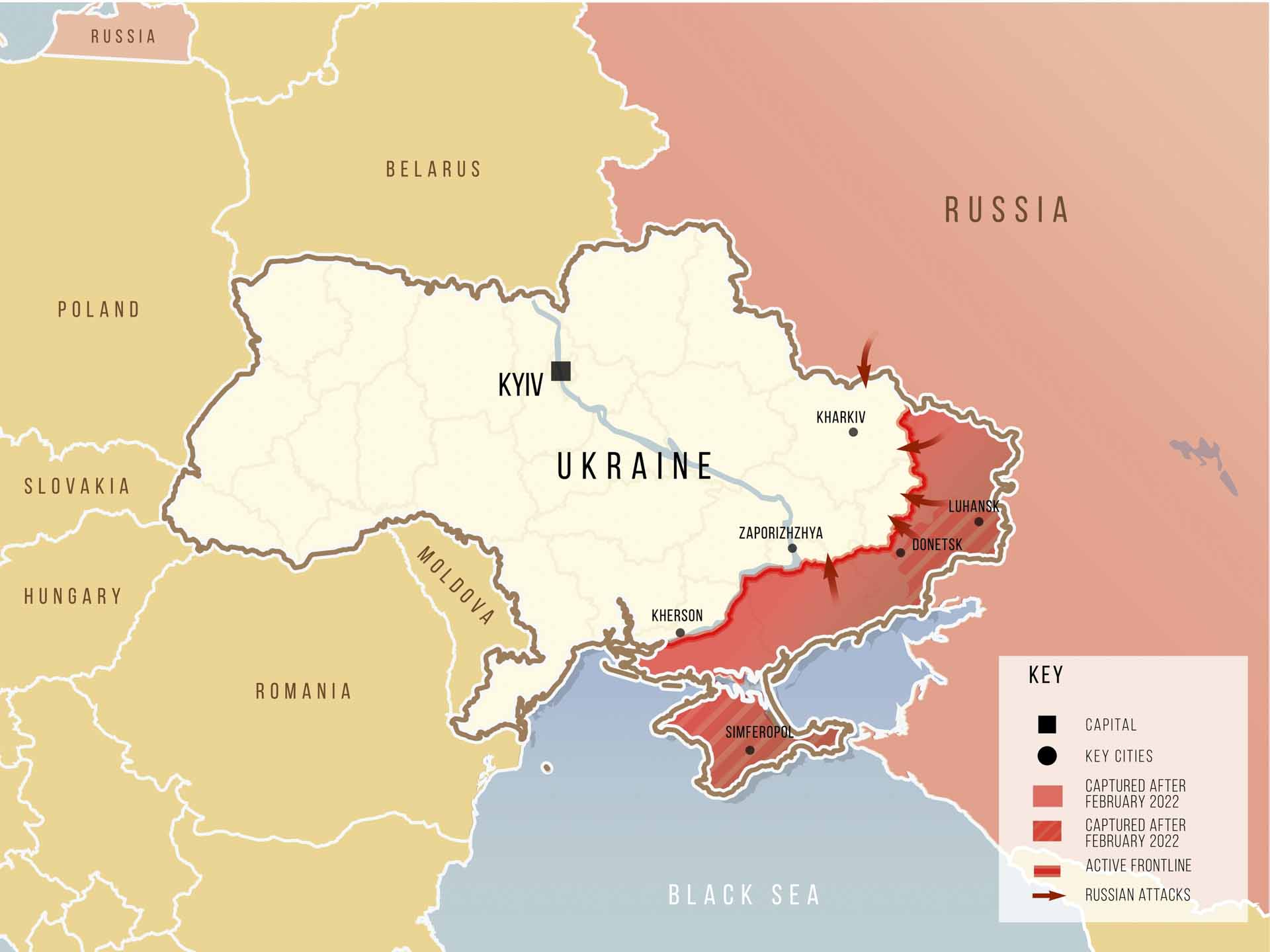
The history of war provides ample evidence that wars have been started because the aggressor has judged it possible to win a quick and surprising victory. When a quick and surprising victory has not proven possible to achieve, a long phase of the war often begins with attrition attempts and battles of attrition in which the aggressor aims to nevertheless be able to demonstrate a final victory. The fact that it is very difficult to achieve peace is naturally related to the fact that the aggressor must seek to end the war with some form of demonstrated victory that creates a reasonable basis for demonstrating to its own population and its own leadership structure that the war was justified. For the attacked party, who feels that it has been completely unjustly attacked and has suffered great material and human losses, it is naturally very difficult to end the war with a peace that is experienced as grossly unjust, especially if the peace leads to losses of its own country's territory.
Prolonged wars with great material and human losses and suffering therefore have other and long-lasting effects, in addition to the fact that the possible limited victory in a peace, for the attacker, may provide a certain justification for starting the war. These long-lasting effects are found in deeper historical and social dimensions and often form the basis for historiography that is characterized by feelings of injustice, bitterness and feelings of hatred and revenge between peoples and can survive for centuries after the wars have ended.
However the Ukrainian war may end, it is clear that these dimensions of the war must be allowed to influence how it ends early on. How reconciliation between Russia and Ukraine can be achieved after the long-term and severe abuses committed by Russia against Ukraine and its population seem like an almost impossible task to tackle.
The reasonable way forward in this area means that the political leaderships of the countries involved in the war feel responsible at an early stage for jointly achieving an objective account of the various conditions that led to the wars, responsibility for various actions during the wars and how the wars led to their conclusion. They must be prepared to enter into a joint dialogue about these conditions and also create information and education to share the results of these joint dialogues with their populations. Independent research must be allowed to participate in this work to create credibility and trust in the results.
Getting the current Russian leadership to accept such work to achieve reconciliation seems like a chimera, but such work must nevertheless begin early within the framework of the UN's responsibility. The work can actually begin now by coordinating various investigative groups that have already been formed regarding war crimes with historical commissions that seek to map the political and military causes and effects of the war. Not least, it is important that the official Russian rhetoric about the causes of the war can be studied in detail and illuminated against the background of the information available in Ukraine and in various sources on the Western side.
The experiences of these conditions after the First World War and the effects of the Treaty of Versailles, led after the Second World War to greater insights into how the aftermath of the war should be handled, not least this was the case on the Western side. Unfortunately, it was not possible to get the then Soviet Union to participate in joint independent research efforts on the different phases of the war, partly due to Stalin's agreement in 1939 with Hitler about Poland, the Baltics and the fact that Finland was given over to the Soviets, something that the Soviets did not want to have independently illuminated and communicated to the Russian population. The Finnish Winter War is still a partially blind spot in Russian historical research.
The Ukraine war was started by Russia and Putin, apparently with the premise of being able to win a quick and decisive military victory, get rid of the political leadership in Kiev and permanently incorporate Ukraine into the Russian sphere of power. The entire political rhetoric surrounding the attack was aimed at making it clear to the Russian population that Ukraine would be freed from foreign (read: harmful Western) and “Nazi” influence, once again become a naturally genuine Russian territory, and that this would be done through a so-called “special military operation”.
The rhetoric was adapted to traditional Russian historical narratives with echoes of 1800th-century philosophies, with perspectives from the Orthodox Church and not least from the Soviet Union's great war against Hitler's Germany. The rhetoric of a so-called "special military operation" can be found in what happened in Crimea in 2015 when the Crimean peninsula was taken from Ukraine through a military coup that bloodlessly led to Crimea's annexation to Russia. The ambition was obviously to repeat this successful model on a larger scale in the attack on Ukraine in February 2022.
It is clear that Putin wanted to avoid a major and prolonged war that could have major political and economic effects on both relations with the West and on Russian domestic development. Being able to demonstrate, not least to his own population, an intervention that would demonstrate Russian strength and political will, and without any actual material or human losses, was therefore an important element of the “special military operation”.
After the large-scale attack failed and the war has now become, not a successful special military operation, but instead appears as a military fiasco and has become an increasingly difficult burden for Russian society, it is clear that this original rhetoric has now created a very strong credibility problem that provides a special prestige boost for Putin and his regime. Namely, if the attacker is an authoritarian state formation, the authoritarian regime's power base is at stake if the war has to be ended with a significant loss of prestige. However, if there are no opposing interests within the regime regarding the war, something that is currently difficult to discern, the conditions for creating internal pressure to seek to end the war are almost hopeless. As long as the war can continue and the authoritarian regime's power base can be maintained even with large both military and civilian losses, the conditions for peace are therefore very difficult to achieve.
That Ukraine, which has been unjustly attacked and managed to prevent defeat, cannot accept peace on any other terms than restoring the pre-war situation and receiving compensation for what was destroyed by the attack, is the only reasonable starting point for this country.
There are therefore several absolutely crucial reasons why the West must assist Ukraine in this war and do so for so long and so forcefully that Putin and his regime cannot win. A first reason is of course that Ukraine's sovereignty and integrity must be secured for fundamental reasons under international law. Should Putin be able to win, even a partial victory, against Ukraine, the way would be opened for continued Russian aggression and expansion westward, something that is already evident from Russian rhetoric against, for example, the Baltic states. A second reason is the Russian rhetoric and behind it a distorted perception of history and ideology that must also be defeated in some way, and must not stand as victors within Russian society. For this reason, it is particularly important that the historiography of the war is given a prominent role early on in independent media and in independent research.
If the regime in Russia, through strongly controlled and manipulated information provision and education, can continue to carry out propaganda that continues to withhold from the Russian population important parts of what happened during World War II, during the Stalin era in Eastern Europe, and portrays the West as a threat to Russian society and that Russia is therefore justified in attacking surrounding states in order to protect itself, a dangerous and permanent state of conflict will prevail that can constantly lead to serious military outbreaks.
In order to avoid this, the West and Russia must find a form of dialogue that seeks to master these very fundamental questions about how our societies are perceived and where the conflicting views have their foundations. This requires a willingness on both sides to unconditionally familiarize themselves with the fundamental historical, religious and social conditions that have characterized the development of societies. This does not necessarily mean that all opinions can be reconciled, but there must be an effort for such dialogue and understanding of each other's integrity that violence and conflicts can be minimized.
The war in Ukraine, however it may end, will lead to a profound bitterness against Putin and his regime and against Russia among the Ukrainian people. Within the EU circle, bitterness and suspicion against Russia are also widespread. Among the Russian public, knowledge of the causes and effects of the war is difficult to clearly ascertain. But outwardly, Putin and his regime still appear to enjoy clear support. These two political and social dimensions of this war in the West and in Russia are two factors that must already be mastered and which must be included as an important dimension in a dialogue with Russia on how this country and the Western world can live together without conflict.
For the Ukraine war to end without giving rise to new conflicts requires a peace that does not give rise to bitterness, hatred and revenge, which in turn requires that the Russian war aims must be abandoned and that the Russian rhetoric about the Ukraine war must take on a substantially different character. How this can be done with Putin remaining in power is difficult to see.