

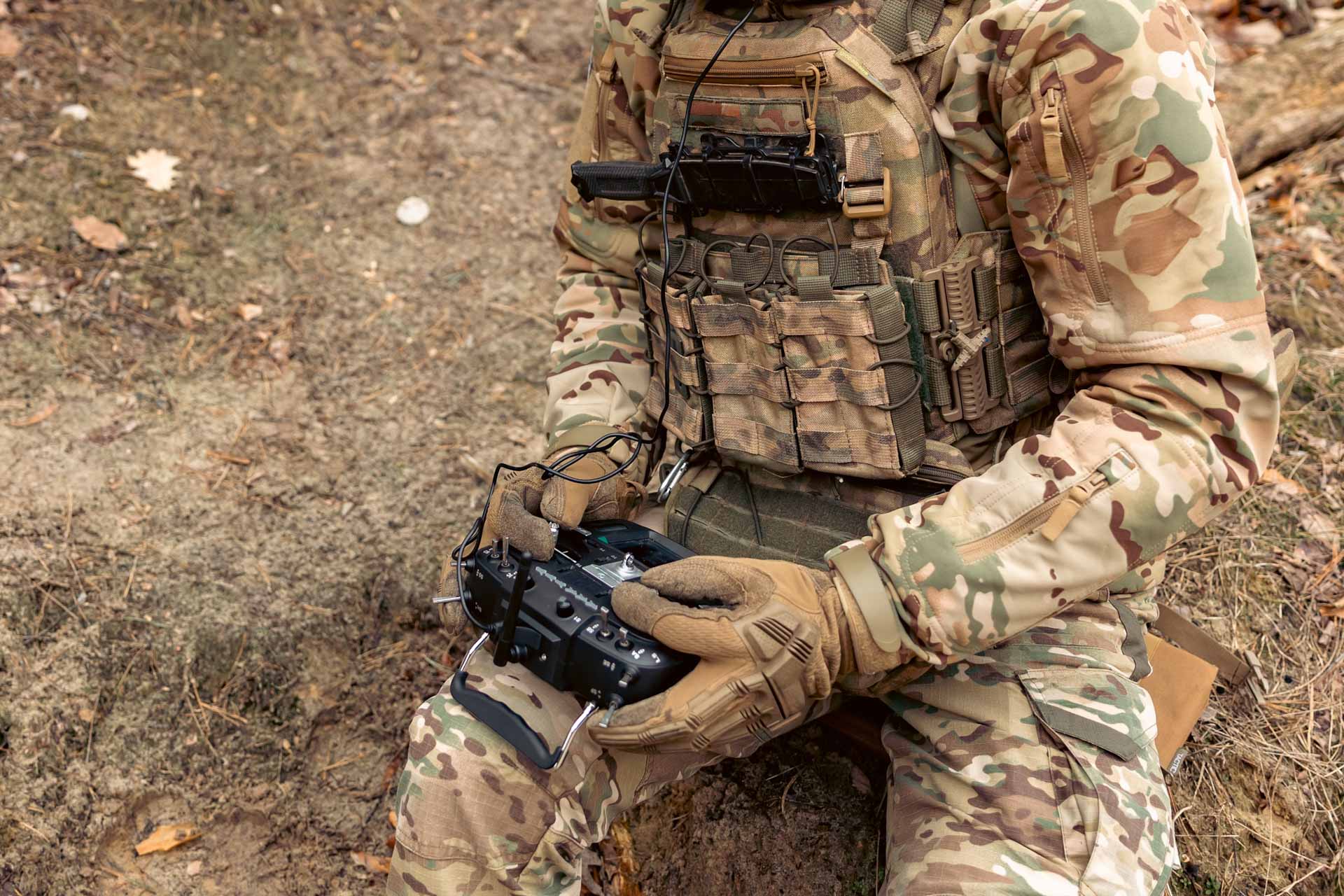
Recent years of warfare have shown the world how commercial vehicles, home-built telewar systems, social media, and digital platforms can not only shorten a chain of action, but also build a resilient action network where sensors are seamlessly connected to action units.[1] Commercially available drone systems, improvised telewar systems, open sources and digital platforms have together contributed to greatly reducing the time between detection and combat. The development has led to a condition called the transparent battlefield. The term is used to describe how the sensor density in Ukraine has made major troop concentrations or command posts impossible as they are immediately detected and combated. At the same time, it is also demonstrably the case that the sensor density has not meant that each warring party has avoided misjudging the tactical situation or, for that matter, failing in certain operations.[2] This will likely also apply in the future, where the choice to take a battle will still mean that the commander takes a risk regardless of how detailed the situational picture is considered to be.[3]
While there is a consensus that the battlefield is transparent, there is room to discuss what kind of clarity we mean and what challenges remain to be addressed to truly achieve a transparent battlefield.[4] In particular, transparency differs between domains and is not just about the visual.
Open source intelligence (OSINT) has proven to have played an influential role in the Russian war of aggression against Ukraine, where methods and technical tools previously used by journalists are now being applied to precision combat both on the front lines and in critical infrastructure in the rear areas. Non-governmental organizations or loosely organized groups of interested parties with limited resources process open information, identify Russian positions, and forward the information to Ukrainian authorities, who then strike at the designated targets.
Sensor density together with OSINT as an intelligence discipline can be seen as an early form of ISTAR 2.0 (Intelligence Target Acquisition Surveillance and Reconnaissance) at the tactical level where brigades and battalions can now act significantly more freely than before. At the same time, it is not a fully developed and fully mature concept that can be applied to every new conflict or, for that matter, introduced immediately in a Swedish context. There are technical, organizational and cultural challenges that must be addressed for a decentralized ISTAR process to function at a lower tactical level. Part of that is to continue to open up the restrictions on the sharing of information.
The transparent battlefield is based on the existence of a network of technical systems that continuously transmit data between all connected nodes. Conventionally, these nodes consist of sensors and processing points that all contribute to a complete situational picture, which is then conveyed downwards based on the information or intelligence needs that have been communicated, with a high level of information protection. Information can often flow relatively unhindered horizontally but becomes more restrictive vertically the further down the organization you go (need to know). This is what can be said to characterize JISR or ISTAR both historically and today.
Breaking away from the “need to know” is the part of the cultural shift that is necessary for ISTAR 2.0 to work. If information is not shared widely and immediately, it does not matter in principle how many sensors or operational units you have connected to the operational network, nor how strong your processing capacity is. The information risks getting stuck in various pipes on local islands where few can access the information, and by the time it reaches a recipient who needs the information, it is probably too late. The focus should be on ensuring that the needs of units at lower tactical levels are met and that these are not overshadowed by the higher staff’s perceived need to visually see the entire battlefield, which in the long run risks leading to micromanagement.
By linking unmanned aerial vehicles, lower tactical signals intelligence, and various engagement platforms in a fully digitalized command and control architecture, real-time situational awareness is combined with precision warfare, drastically increasing the speed of the combat cycle. In Ukraine, drones connected to various software have reduced the time from target identification to artillery combat to a few minutes. I have previously written about how information paths must become information superhighways.[5] This means that the information must not only be able to flow quickly in terms of the number of bits per second, but also flow in parallel in several path files and in data formats that are easy to process. The Armed Forces have started to move in that direction and in the Air Force, for example, ATAK (Android Team Awareness Kit) is starting to find its way to lower levels, which will be an important part of building a situational picture within the defense branch. Thus, there are all the conditions for the Armed Forces to be able to achieve both fast and robust combat networks where all sensors are connected to all operational elements at all levels.
At the same time, it is not enough to have sensors that detect and transmit information over a transmission medium. Processing and analysis capacity is also needed to put things in context, to be able to understand what is happening or is about to happen and to make well-founded decisions. Open sources do not just mean passively receiving information and processing it, it also allows intelligence officers to be active in their collection. Among other things, OSINT can function as a bridge to HUMINT when intelligence officers get in touch with sources that can actively help build a more high-resolution picture of the situation. This was exemplified during the West's intervention in Libya, where a French intelligence officer was able to build a network of around 250 informants who were on site in the area.[6]
The increased availability of data in both quantity and speed risks creating an illusion of understanding. There is a real risk that the information from a sensor trumps the intelligence commander's judgment when the commander decides which course of action to take, or that the amount of information simply leads to cognitive overload.[7][8] In practice, the demands for interpretation, validation and contextualization are rather increasing. The transparent battlefield is in reality an incomplete and sometimes misleading construct.[9]
Data is not the same as intelligence or knowledge. To achieve knowledge, we need to put data in context, to gain contextual understanding, which lays the foundation for us to be able to gain knowledge about the situation. This in turn is important for us to be able to understand everything we see and be able to (re)act in order to be able to use the situation to our advantage. That is, even though we can today train AI models to calculate where it is optimal to place a radar system from the outside, we still need to take into account that it is people who make decisions and that these are far from always optimal in themselves. Despite its advantages, transparency will always be limited by human interpretation errors and enemy actions through masking and deception.
More artificial intelligence (AI) will not be the solution to the problem, even if AI can relieve and help with much of the data management. For AI to be the catalyst that the organization wants, it needs methods and personnel with the right skill profile to handle the data that is entered into the system as well as to interpret the data that is taken out of the system. The data that is presented in different ways after being processed by AI will not be of higher quality than, for example, the staff assistant's ability to structure the information at input.[10] This means that it will continue to be critical to recruit and train competent individuals to staff various assistant positions in the organization, and that these are continuously trained as management support systems are introduced and developed. This is important in order to be able to build trust in the basis for military leaders to dare to make decisions.
ISTAR 2.0 is based on an innovation logic that is fundamentally different from how the Swedish Armed Forces traditionally drive development. There is also a lot of talk about the need for the military forces within NATO to become more innovative. The Swedish Armed Forces are by no means an exception. The concept of “innovation” has in a short time become the new “operational effect” or “threshold effect”. It is not my intention to be lenient on the issue but to point out bluntly that the concept has lost some of its meaning, especially when it can now be said that what we really mean is “generals’ innovation” (top-down) instead of “soldiers’ innovation” (bottom-up). Of course there are exceptions, but the introduction of experimental offices, special projects and FMV’s “Battle Week” all consistently indicate that innovation is expected to come from the top, in the form of large transformative projects that will revolutionize Swedish warfare. Which goes against the experience reporting coming from Ukraine where it is rather small-scale projects that respond to specific perceived problems at the front that account for innovation. The bottom-up-driven innovation in Ukraine is not a sidetrack, but a prerequisite for ISTAR 2.0 to function at the tactical level.
This particular form of innovation presupposes, or rather demands, that there are individuals throughout the organization who in various ways invest their own resources in the form of time and energy (sometimes even money) to design solutions. That innovation will probably not be delivered from central processes or multinational companies, simply because the cost calculations do not add up. The innovative challenge for the central level will instead be to link the various local solutions together and make them transferable between areas of operation and domains. For industry, the challenge will be to make small solutions scalable and adaptable enough that they have a reasonable chance of surviving more than a few weeks. That said, we must realize that the economic game that we have become accustomed to in peacetime no longer applies.
The current logic around innovation can be visualized with a triangle. The innovation triangle means that we cannot acknowledge the different interests that the state, industry and the soldier have. If the state is to save money, or at least keep costs down, it will negatively affect industry and the soldier. If industry is to have the opportunity to extract profit and dare to invest in the long term, it will be at the expense of both the state's economy and the soldier's need for quick solutions. If the soldier is to be prioritized through quick solutions with a limited time horizon, it must be at the expense of both the state's economy and the industry's demand for returns. This may seem like a pessimistic view of the way forward, and it will possibly meet with resistance from those involved in one of the central processes. At the same time, this paradigm must be made visible and discussed openly if we are to have a chance of achieving what we say we want to achieve in the form of an innovative defense force where the unit's war capability is at the center. It is then reasonable that the soldier's interests should take precedence over others by dedicating resources in the form of capital and personnel to helping advance soldier-related innovations.
The Armed Forces are on the hunt for innovative technical solutions for the war of the future. In this pursuit, we must not become blind to the organizational and, not least, cultural innovations that are also necessary to be able to capitalize on the technical solutions. Especially if we want to find functioning soldier innovations that can be implemented here and now instead of visionary general innovations that may never have time to be delivered to the units before the war is over.