

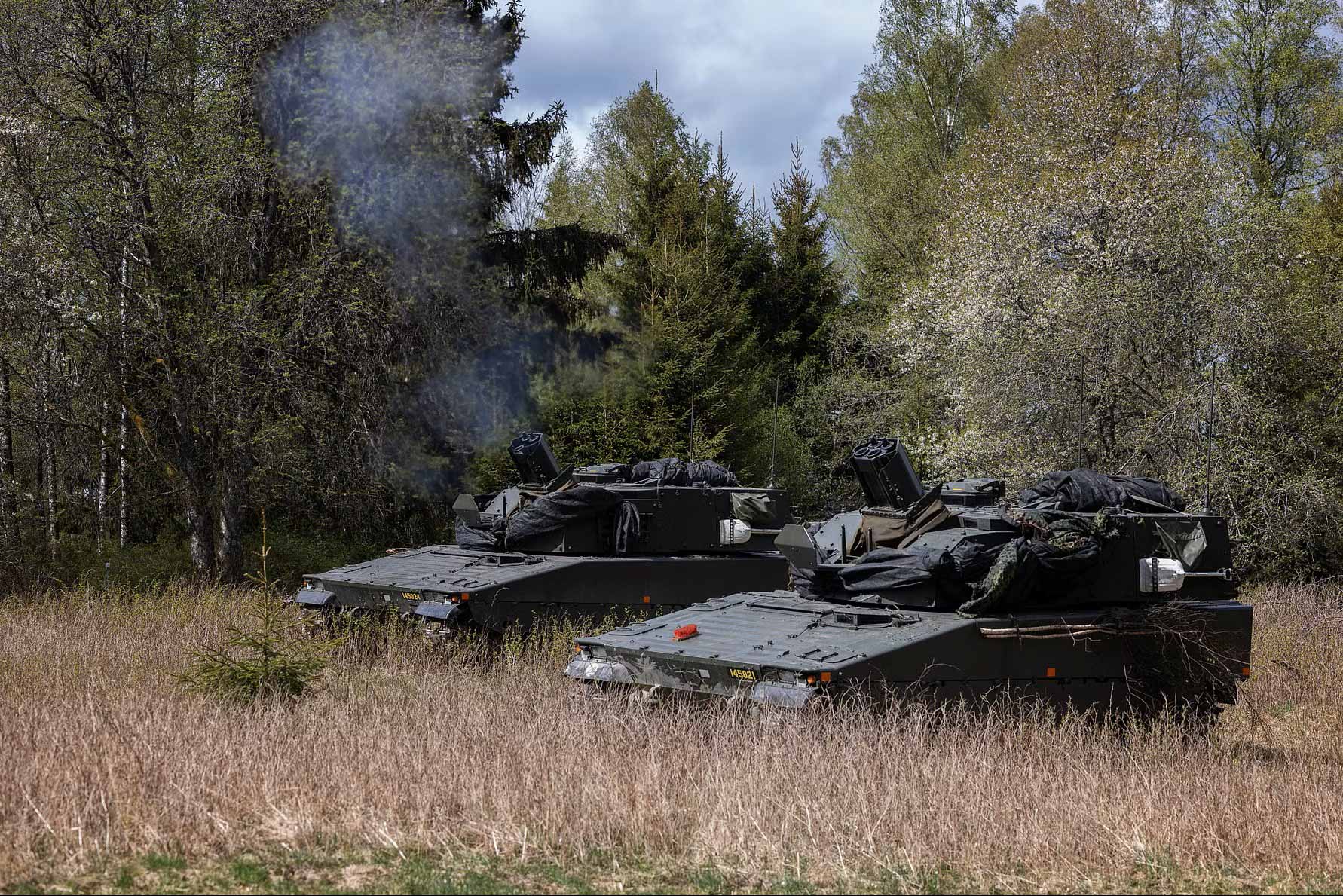
The international situation is characterized by Russian aggression against Ukraine and poses the most serious threat to Sweden since World War II.[1] For Sweden, this has resulted in the largest rearmament since the 1950s and membership in NATO.[2] The implication of being an alliance member is a fundamental change in how Sweden needs to plan and prioritize its military resources. In an alliance, this is done together with others, which means that Sweden must focus on how we effectively contribute to NATO's collective security.
The consequence of being a NATO member and thus planning according to NATO's needs raises the question of which military capabilities Sweden should prioritize. Today, Sweden continues to invest more in capabilities linked to the sea and air domains than in the land domain.[3] This risks creating an imbalance between the demands that the war against Russia will place on us, our expected contribution to NATO and our actual warfighting capability. This article therefore argues that Sweden needs to increase the priority of our ground forces' capability development. The basis for this is three main reasons: the crucial role of ground forces in military strategy, lessons from the war in Ukraine and NATO's needs in the Swedish vicinity, especially in the Arctic.
By analyzing these factors, the article demonstrates that the Swedish ground forces are of great strategic importance to the alliance. Consequently, there is a need to prioritize ground combat units in order for Sweden to effectively contribute to NATO's deterrence and possible defense against Russian aggression.
Background
Sweden and Finland became NATO members as a result of Russia's full-scale invasion of Ukraine in 2022.[4] Sweden has more than doubled its defense budget since the beginning of the 2020s. In 2025, it consisted of about 2,4% of Sweden's GDP. The goal is to at least reach NATO's expected levels, 3,5% of GDP by 2030.[5] Several NATO countries in Europe are rearming with a focus on ground combat capabilities. From 2024 to 2025, Germany has increased its army budget by 70,5%, compared to a 2,4% increase for the air force and a 22,1% increase for the navy. The Dutch army also has a larger budget than the other two domains and is also reintroducing the main battle tank.[6] Consequently, this means that even the European NATO countries that are not frontline states against Russia are investing in ground forces.
Sweden risks instead continuing to focus on the air and sea domains as investments in these continue to increase at a higher rate than in the land domain. The increase in air equipment was 92,5% from 2023 to 2025, despite a planned increase of 77,6%. The same trend applies to naval equipment, which increased by 191% and the planned increase was 113%. This is in comparison with equipment for the land arena, which had an increase of 52% despite a planned increase of 106%. This shows how Sweden continues to underfinance the ground forces despite their special position in terms of military strategy and importance for NATO's collective defense.[7]
Ground forces
Ground forces have a special position in military strategy due to their unique ability to capture, control and defend territory. Air and naval forces enable the sustained presence of ground combat units through temporary and indirect action.[8] But the decisive factor in, and the ultimate purpose of, warfare is to control the geographical areas where the state's population, resources, and political institutions are located.[9] Thus, territorial control is the fundamental task of a defense force in order to protect citizens and secure the country's sovereignty. Ground combat units are the basic prerequisite for this.
The ability to control land areas is also central to the effectiveness of other combat forces, but also to NATO's collective capability. First, all domains' operations depend on bases, logistics and command functions that are largely located on land.[10] Secondly, Sweden will be the host nation, which means that NATO's supply of combat forces will go through Sweden.[11] Both of these factors therefore place high demands on Sweden's ability to protect and defend land areas and movements, something that is primarily done by ground forces and air defense.[12] If this works poorly, the implementation of operations with other domains and NATO's force growth, and thus ours, are limited. In addition, there is the factor of volume for the ground forces in order to be able to protect our own population, the continued operations of the state and the civilian components of total defense. A responsibility that continues to rest on national capabilities regardless of alliance membership.[13] In a conflict, ground forces are thus a critical enabler for NATO's growth in strength, for Swedish society to be able to function, and for the other domains' possibilities for intervention.
Among the other domains, the air force and navy are platform-based. These are very costly, while at the same time being particularly visible in Swedish defense policy.[14] The army has platforms such as tanks, artillery and anti-aircraft guns, but above all it is the soldier who is at the center. Taken together, these are components that may not have the same effect when displayed and therefore are not as visible. This is because they are not perceived to have the same prestige value as aircraft or frigates. On the other hand, the ground forces' units and capabilities generate significant effect per invested krona. The ground combat soldier with his systems is a fundamental prerequisite for achieving the Armed Forces' objective of securing the state from an aggressor. The fact that the capability is also relatively cheap should mean a greater willingness to invest in it. This is despite the fact that it is more difficult to use as a political symbol. In addition to their critical function in war, ground combat units also have an important function in peace as support for civil society in the event of accidents and disaster situations, for example.
In peacetime, ground combat power plays a crucial role in military deterrence.[15] By being visible to the opponent, by signaling presence, and perseverance and thus will.[16] Unlike, for example, air forces that operate over long distances without a permanent presence, ground forces demonstrate a concrete commitment.[17] This increases the credibility of deterrence, as it clearly demonstrates both the will and ability to defend the territory.[18]
NATO demonstrates this intention through its Forward Land Forces (FLF). The Swedish contribution to FLF Latvia is part of a multinational brigade, while Sweden is the framework nation in FLF Finland.[19] These forward-deployed forces demonstrate the alliance's ambition regarding deterrence and preparedness in the form of ground forces, particularly in the Baltics and the Arctic, where NATO has limitations when it comes to reinforcing ground combat forces.[20] Due to the geographical proximity, Sweden's responsibility through participation in two FLF structures is natural, but it also entails an increased need for us to invest in ground forces. This is to contribute effectively to NATO's collective defense by achieving the deterrence that the operation aims for.
Next war
The Swedish contribution to NATO's collective defense needs to be based on an analysis of how the next war will be fought. However, lessons from previous and ongoing conflicts, such as the Ukraine war, need to be interpreted with caution. The reason is that it has proven impossible to predict the next war.[21] Therefore, it is necessary that identified lessons are not implemented uncritically in capability development. There are several factors that distinguish the war between Ukraine and Russia from the possible war between NATO and Russia, for example at the strategic level, possible implementation of operations and tactics and combat technology plus of course climate and terrain.
The difference at the strategic level between the ongoing Ukraine war and the possible war between NATO and Russia is both political goals and resources. This affects Russia's options for action. For example, Russia is developing its mass mobilization function and expanding its standing army, which means different conditions in a war against NATO. A mass mobilization in the war against Ukraine is not politically feasible in Russia.[22] The implication of this is that the Ukraine war cannot be seen as a model for future wars, but a specific case characterized by limited options for action. Sweden must therefore base its decisions on a broader basis than just observations from Ukraine.
The war in Ukraine has been largely characterized by static front lines and a form of war of attrition.[23] However, this should not be understood as meaning that maneuver warfare is not still relevant. First, Russia's initial operation was a failed attempt to take Ukraine through maneuver warfare.[24] Thus, today's front line should be seen as a consequence of failed maneuver warfare, as Russia instead chose to quickly take terrain and hold on by digging in. To then retake terrain defended by extensive mining, indirect fire support and surveillance by drones requires a lot of resources, time and blood. [25] Second, both Russia and Ukraine lack operational reserves and thus have limited ability to carry out the maneuvers required to achieve breakthroughs. In Ukraine's case, it is because they are too few, and in Russia's case, it is because of domestic political considerations that limit mobilization. Without reserves, units need to be taken from other parts of the front, which increases risk-taking.[26]
This risk-taking is all the greater as maneuver warfare involves a higher degree of risk-taking than static combat. Maneuver warfare enables success with relatively few resources and reduces the risk of locked positions of the type we see in Ukraine.[27] Using maneuver warfare is an advantage for NATO as Russia has proven to be stronger in defensive combat in relation to its maneuver capabilities.[28] In addition, the war in Ukraine demonstrates that it is difficult to achieve breakthroughs when static positions are occupied and defended. This suggests that maneuver warfare will be a desirable component of a future war and that Sweden should therefore continue to develop the maneuver capability of its ground forces. A capability that Sweden has assessed as an advantage in comparison with Russia. By building on this strength, in combination with winter combat competence, Sweden, together with Finland, will have good prospects for success.
The Swedish operational environment means that geographical and climatic factors also constitute further decisive factors that limit the transferability of experiences from Ukraine. The factors affect, for example, both combat technology and equipment. For example, drone systems can be negatively affected by cold through reduced battery life, technical reliability and reduced visibility due to high humidity.[29] The conclusion is therefore that equipment that is effective in Ukraine should not be taken for granted in a Swedish operational environment, which also means that the combat technology used is not directly transferable. Instead, Sweden should focus on what lessons are applicable to our conditions.
North Calotte
For NATO, the Arctic Ocean is an area of particular strategic importance. The region is also of great interest to Russia, for example the base area around Murmansk, and is therefore critical for NATO for both deterrence and defense. Control of the area is therefore crucial to limiting Russian freedom of action and to guaranteeing the security of the alliance.[30] The consequence is that Swedish ground combat capability in this area is of particular importance to NATO given our ability in sub-Arctic climates.
The special geographical and climatic conditions in the Arctic Ocean place high demands on military capability. This is because cold weather, darkness, snow, difficult terrain and limited infrastructure have a major impact on the units and the way the battle is conducted. The ability to operate in this environment places high demands on equipment, training and experience of winter conditions.[31] Norway, Finland, Sweden and the United Kingdom are the only countries in European NATO that have subarctic competence.[32] Developing such a system for other countries is considered to be very costly. This gives Norway, Finland and Sweden a special position in the alliance's defense as the countries train and operate in this environment. It is therefore reasonable that they also have a special role in being responsible for ground control in the relevant geographical area.
NATO has three Joint Force Commands (JFCs) with different geographical areas of responsibility. The Nordic countries are part of JFC Norfolk in the USA, while Poland and the Baltics belong to JFC Brunssum in the Netherlands.[33] It can therefore be assumed that the countries in the respective JFC are expected to operate within these: the Central European countries on the eastern flank and the Nordic countries in the Arctic and the Arctic. Sweden, Finland and Norway are special because of their expertise in winter combat.[34] But Norway has a strong focus on naval forces due to its long coastline and strategic position near Arctic sea areas and Russia.[35] This means that it is strategically necessary for Sweden and Finland to develop and maintain a powerful ground combat capability adapted to the region's specific and demanding requirements.
Ground control of the region is required to prevent Russia from being given the opportunity to expand and strengthen its zone of control, for example by taking areas along the Norwegian coast, which would negatively affect NATO's freedom of action in the North Atlantic and the Arctic. By maintaining a strong ground presence in this region, NATO can limit, and ideally prevent, such a development.[36]
Sweden should contribute by developing capabilities where we have a comparative advantage. In the Baltic Sea region, there are several NATO countries with significant naval resources, which enables a division of labor where Sweden's contribution can be more niche. One example is the Swedish submarines, which are a welcome capability contribution to NATO's defense of the Baltic Sea.[37] In the Arctic, the availability of qualified ground combat units is limited while the needs are great, linked to the number of units and the region's strategic importance.[38] This means that we have a strategic responsibility to focus on ground combat capability. This is because Sweden has the critical winter expertise and terrain knowledge. In addition, the region is our geographical vicinity and therefore also a natural area of responsibility, and in order to be able to shoulder this responsibility, a clear prioritization of ground forces is required. This is not only important for national security but is a prerequisite for Sweden to be able to contribute effectively to NATO's collective defense.
Modern warfare
Experiences from Ukraine indicate that modern warfare is characterized by an increased dominance of air and precision combat as well as a transparent and thus relatively static battlefield.[39] This could be interpreted as a deprioritization of ground combat capabilities as their relevance would have decreased. However, this is a wrong conclusion. The war in Ukraine has certainly demonstrated the increasing importance of long-range precision combat and drone warfare, but none of that replaces the need for ground territorial control.[40] Instead, the importance of joint operations is demonstrated as these capabilities are a complement to achieving the effectiveness of ground combat units.[41]
The battlefield in Ukraine features trenches, artillery fire, and extensive field work aimed at controlling land areas.[42] Furthermore, drones are not only used as operational elements, but are also widely used to direct artillery fire and gather intelligence.[43] The situation on the battlefield has certainly influenced tactics and contributed to more static positions, but is largely a result of limitations in resources and maneuverability.[44] Overall, this means that drones are part of the ground war and is not proof that the importance of ground combat has decreased.
Developments in the air and naval domains reinforce this picture. In Ukraine, both parties have effectively limited the freedom of action of their air forces through the use of air defense, where army air defense in particular has been successful.[45] In addition, Ukraine has carried out a successful drone offensive, in which more than 40 Russian aircraft were destroyed.[46] Furthermore, Ukraine's unmanned vehicle capabilities have also been able to sink a third of the Black Sea Fleet. This without the country having its own conventional naval forces. At the same time, Russia does not dare to appear within range of Ukrainian missiles grouped on land.[47] This shows that all domains, not just ground combat units, are vulnerable in a warfare characterized by unmanned vehicles. Thus, there is a need for ground forces to control the ground in order to threaten the opponent's air and naval forces and to form bases for their own capabilities. In addition, it shows the need for joint operations to cover the different vulnerabilities of the domains and complement each other's strengths.
Conclusion
The article has attempted to demonstrate that the Swedish land combat capability constitutes the most relevant and strategically significant contribution to NATO. As a member of the alliance, Sweden should plan its military resources based on how they most effectively contribute to collective defense. This means that current investments in the maritime and air domains are strategically insufficient in relation to the alliance's needs. Instead, the Swedish land combat capability is crucial for NATO's deterrence and defense, which should be Sweden's priority.
The analysis is based on three central factors. Firstly, the ground forces have a special position due to the unique characteristics of the domain. The ground forces are the critical component for maintaining a sovereign state and securing the population. Secondly, the war in Ukraine shows that maneuverability is important in order to avoid a war of attrition and that experiences from the war cannot be uncritically transferred to our circumstances. Thirdly, the Arctic Ocean is of great strategic importance to NATO. The implication is that the Swedish contribution of ground troops is particularly important as Sweden has a clear comparative advantage in the form of winter combat competence.
Overall, this means that the Swedish ground combat capability constitutes a basic prerequisite for NATO's collective defense. Failure to re-prioritize risks reducing Sweden's relevance within the alliance and its overall defense capability. This is because ground control is a fundamental part of being able to carry out joint operations with the aim of defending our population and sovereignty. In addition, it is primarily the Swedish ground combat capability that is in demand in NATO in order to be able to meet an aggressive Russia. It is therefore a strategic necessity that Sweden prioritizes the rearmament of ground combat forces that are trained for the specific demands that our geographical region places on us. Prioritizing these is not only a matter of national security, but a strategic necessity for Sweden to be able to effectively contribute to NATO's collective defense.