

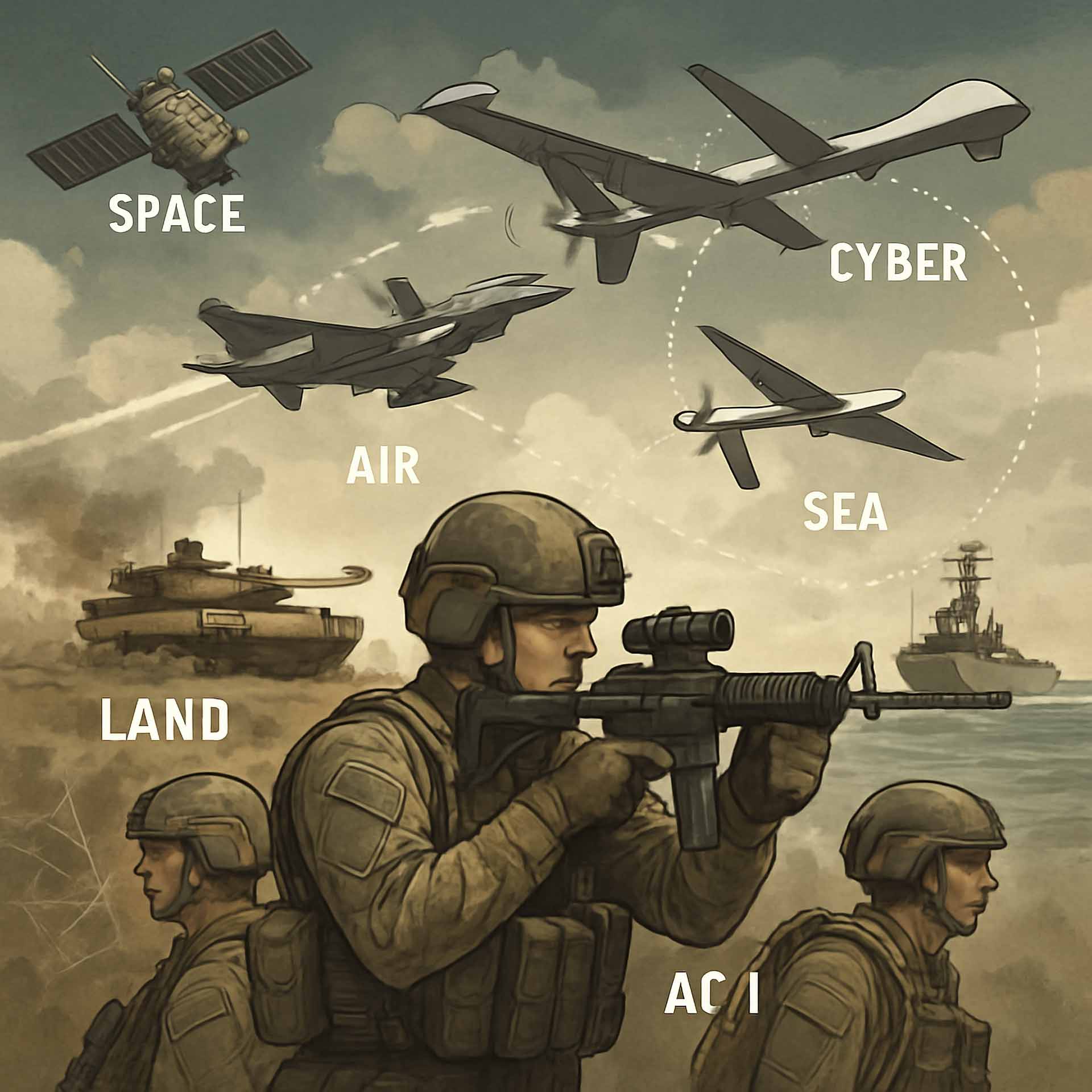
The Armed Forces' choice to develop the capability for multi-domain operations, MDO, is logical. In a modern conflict, land, sea, air, cyber and space domains cannot be treated separately. Military activities must be orchestrated across domains and simultaneously synchronized with civilian and other non-military actors. The goal is to create convergent effects faster and more effectively than the adversary.
But, the more interconnected the system becomes, the more important another question becomes: How does a staff discover that its own way of planning, evaluating and adapting the operation is taking the system in the wrong direction?
It is not enough to follow the opponent's dispositions, one's own combat forces and a number of performance indicators. A complex command system can also create problems through its own feedback loops. In system dynamics, such recurring structures are usually described as system archetypes.
They should not be considered ready-made templates to be superimposed on an operation. Instead, they can be used as hypotheses about dangerous feedback patterns. If such patterns can arise in MDO, the staff should also have indicators that show when it is entering them.
When the target starts moving
A clear example is the system archetype Drifting Goals – creeping or eroding targets.
Assume that a military objective is translated into a future desired system state, a FÖS[1]: an explicit answer to the question of what state we want the surgical environment to be in after the surgery.
The operation is carried out, after which the staff evaluates the outcome.
There are two completely different issues here that should not be mixed up.
The first is: Did we achieve the goal we previously decided on?
The second is: Is this still the right goal?
The first is performance evaluation. The second is strategic reassessment.
If these are mixed together, there is a risk. When the operation does not achieve the original goal, the organization can gradually change the goal itself so that it better corresponds to what has actually been achieved. The gap between the desired and actual state decreases – but not because the operation has improved, but because the goal has been moved.
It is the classic structure Drifting Goals.
Not all changes in goals are, of course, goal slippage. A changed environment, new political decisions, changed adversarial capabilities or unacceptable costs can make a goal revision completely rational. The problem arises when the goal is changed primarily because it has proven difficult to achieve.
Therefore, the staff needs to be able to distinguish between: – plan failure and goal infeasibility.
The failure of a plan does not automatically mean that the goal is impossible.
More system archetypes can affect MDO
Drifting Goals is likely not the only feedback trap relevant to multi-domain operations.
Another candidate is Shifting the BurdenA difficult structural problem can have a quick symptomatic solution that works in the short term but at the same time reduces the incentive to develop the fundamental ability.
In a management system, for example, it could mean that a lack of shared situational understanding is met with increasingly centralized management. This can improve coordination here and now, but at the same time reduce local initiative and make the organization even more dependent on central management.
A third risk is Success to the SuccessfulThe domain or activity that produces clear and easily measurable results early on gets more attention and resources. This produces further visible results, which motivates even more resources.
MDO may thus paradoxically become less multi-domain. Effects that are difficult to observe – for example, certain cognitive, cyber-related or civil-military effects – risk being underestimated in favor of those that are easier to measure.
Another candidate is Growth and Underinvestment. A unit or function is used increasingly hard to meet an increasing operational need. The short-term effect increases, but attrition, personnel load, ammunition consumption and maintenance requirements simultaneously build up a delayed limitation. If investments in endurance come too late, the actual capability decreases.
And between Blue and Red is the classic Escalation-structure. One party's increased effort creates a perceived disadvantage in the other party, who responds with increased effort, which in turn drives the first party further.
In Ukraine, we have seen how means, countermeasures and counter-countermeasures can evolve very quickly. An MDO plan must therefore be tested against an adaptive adversary, not just a statically described adversary.
The problem is not knowing the archetypes
There is an obvious risk in using system archetypes: you see what you are looking for.
If a staff decides in advance that a situation is Escalation or Shifting the Burden the analysis can be as misleading as if the archetypes were not used at all.
Therefore, the process should be the reverse.
First, variables and observable relationships are identified. Then, it is tested which causal links can actually be established. Only when the links together form a closed feedback structure should an archetype label be used.
The order should therefore be: observation → causal link → feedback loop → possible system archetype. Not the other way around.
What does the staff need to observe?
That leads to the practical question: what indicators could act as warning lights?
For Drifting Goals Some simple questions could be:
- How often does the future desired system state change?
- How big is the change compared to the previous version?
- Have the values, political conditions, the opponent or the resources actually changed?
- Or, does the change in goal mainly coincide with the failure of the previous plan?
For Success to the Successful can the staff follow:
- How resources are distributed between domains over time.
- Whether the resource allocation follows actual importance for goal achievement or previously visible success.
- If easily measurable effects are systematically given greater weight than those that are difficult to measure.
For Growth and Underinvestment indicators should include:
- Ability utilization.
- Technical wear.
- Staff workload.
- Spare parts and ammunition.
- Recovery and education.
- The delay between increased need and reinvestment.
For Escalation it becomes relevant to follow:
- Own bet increase.
- The opponent's response.
- Costs for both sides.
- If each side's action systematically becomes the driving force for the other's next action.
The important thing is that the indicators not only show how the operation is going, but also how the management system itself changes the operation.
A need for two feedback speeds
In my opinion, this is an important design principle for MDO.
The quick feedback should be: situation → valuation → new COA[2] → implementation.
Phronesis[3] – practical wisdom – must be able to adapt actions quickly.
The slower feedback should be: situation → strategic reassessment → possible change of goal.
It is dangerous if the same rapid feedback used to change a COA also inadvertently changes the goal itself.
A practical solution would therefore be to version-lock the decided goal and always first evaluate the outcome against the version that was in effect when the operation was decided.
Only then will the question of a new version be raised.
This can be described as a FÖS Change Gate[4]:
- What was the previous goal?
- How big is the gap to actual outcome?
- Is the goal still achievable?
- Are there alternative courses of action?
- Is the cost still acceptable?
- What actual change justifies a new goal?
- Who has the mandate to decide on the change?
A previous goal may never be overwritten. It is kept as a reference.
From planning support to hazard monitor[5]
This leads to a possible further development of the MDO staff work.
In addition to regular planning, you could have an MDO Archetype Hazard Monitor.
It would not make decisions and would not claim that an archetype exists. Instead, it would give warnings of the type Possible Drifting Goals[6]-structure.
For the future desired situation, FÖS, which originally had a set of strategic goals and system states. These combined system states have changed during implementation, thereby changing the FÖS three times, while the value base, threat image and decided cost tolerance have remained unchanged. The strongest explanatory variable is failure to meet goals.
Or: Possible Success-to-the-Successful structure[7].
Over three planning cycles, 62 percent of the new resources have gone to the domain that has had the best measurable impact, even though its marginal contribution to the overall end goal has decreased.
These are not automatic decisions. These are issues that the staff should be forced to confront.
MDO doesn't just need situational awareness
MDO rightly relies on better situational understanding, interoperability, information sharing and the ability to create convergent effects.
But in a complex system, something that can be called self-understanding is also needed.
The staff doesn't just need to know: – What is the opponent doing with the system?
It also needs to be able to ask: What does our own way of planning, measuring, prioritizing and reacting do to the system?
This is the most important contribution of system archetypes.
They are not forecasts. They are cautionary hypotheses about how perfectly rational local decisions can together create undesirable system behavior.
Conclusions
The Armed Forces' development towards MDO should therefore be supplemented with systematic work to identify feedback risks in their own management process.
It is not about adding another method on top of already burdened staffs. On the contrary, a limited number of indicators should be able to function as warning lights at important decision points.
The question is not just: Has the situation changed?
But also: Has our model of success changed because the situation has changed – or because we failed?
Not only: Which domain produces the most impact?
Without: Is it also the domain that is most necessary for the overall goal?
Not only: Do we need to do more?
Without: Does our response drive the opponent to a response that forces us to do even more?
And not only: Which COA should we choose?
Without: Is there a feedback structure that systematically makes our successive COAs worse despite each individual decision appearing rational?
MDO requires the ability to see across domain boundaries.
The next step should be to also be able to review the feedback limits in one's own staff work.
It is only then that the multi-domain operation becomes not only coherent and adaptive, but also aware of the systemic traps that its own adaptation can create.