

Enhanced deterrence and resilience
with Sweden in NATO and the EU
– man
Global developments require SV-AR…
In the near future!
Interim report year-end 2024/25
Part I
Lars Erik Lundin
Michael Sahl

EXECUTIVE SUMMARY
The report, titled “Enhanced Deterrence and Resilience with Sweden in Nato and the EU – but global developments require SV-AR – action”, presents a critical analysis of the evolving global landscape and its implications for Sweden's security and defence policies. It emphasizes the need for rapid adaptation and a move away from traditional, sequential approaches to defense building.
Key takeaways from the report includes:
- The Urgency of the Situation: The report suggests that Sweden could be at war within the next few years, highlighting the need for immediate action. It stresses that a reactive security policy could lead to serious threats to Sweden in the latter half of the 2020s. The document emphasizes that the world is facing a period of instability with increasing risks of global system collapses and related war risks.
- Impact of Trump's Presidency: The report underscores the potential impact of Donald Trump's return to the US presidency, noting his "America First" policy and preference for bilateral "dealmaking". It raises concerns about the unpredictability of US foreign policy and the need for Europe to be prepared to act independently. Trump's administration is expected to bring about significant changes in American society, including its foreign policy. The report suggests that the window for Trump to implement rapid changes may be short, perhaps less than two years.
- Need for Enhanced Total Defence: The report calls for a significant and rapid strengthening of Sweden's total defense capabilities, including both military and civil aspects. It criticizes the current, sequential approach to defense development as insufficient. The report stresses the necessity of moving away from lengthy investigations and budgetary negotiations and instead to adopt a faster decision-making process. The report notes that Sweden must strengthen its ability to defend itself, aligning with Article 3 of the NATO treaty, not as a long-term ambition, but within a couple of years.
- Importance of International Cooperation: While emphasizing bilateral cooperation, especially with the US, the report also stresses the importance of multilateral alliances through NATO and the EU. It highlights the necessity for Sweden to work closely with Nordic and Baltic countries, as well as with key European partners like the UK, Poland and Germany. The report suggests that Sweden should work towards enhancing the Chinese dependence on the West to prevent an alliance between China and Russia.
- Focus on Deterrence and Resilience: The report emphasizes the importance of both deterrence and resilience for Sweden's security, highlighting that these concepts must be viewed holistically. It warns against solely relying on NATO for deterrence and stresses that Sweden itself must enhance its own capabilities. The report indicates that a lack of public confidence in democracy and the rule of law can lead to a decline in society's resilience.
- Global Instability: The report paints a picture of a complex and increasingly unstable world, with multiple interconnected crises. It mentions the wars in Ukraine and the Middle East, as well as the long-term risk of conflict in Southeast Asia/Taiwan. The report acknowledges that conflicts far away from Sweden can still pose a security risk. It identifies a trend of erosion in established international norms and mechanisms for resolving disputes.
- Specific Recommendations: The report provides numerous specific recommendations, including the need for an investment fund for total defence, increased NATO control over the Baltic Sea, and the strengthening of the Swedish navy and coast guard. It also calls for faster officer training programs, and the development of measures against hybrid threats. It emphasizes the need for enhanced cooperation with the US, especially in the areas of the North and space/air.
- Hybrid Threats and Societal Resilience: The report stresses the importance of addressing hybrid threats, which are seen as an ongoing and escalating global issue. It highlights the necessity of developing countermeasures and proactive measures to build societal resilience against such attacks. The report also notes that a decline in democratic values and the rule of law can weaken societal resilience.
- Consequences of a Frozen Conflict in Ukraine: The report highlights the risk that if the conflict in Ukraine is frozen rather than resolved, Russia could have strategic space to move resources to the North European region. This could significantly worsen the security situation for Sweden and the other Nordic countries..
- Need for Critical Analysis: The report stresses the importance of critical and nuanced analysis, rather than linear projections of current trends. It cautions against a simplistic view of cooperation within the West and argues for an awareness of the potential for disruptions and instability. The report indicates the importance of not just focusing on NATO's role, but also the necessity of bilateral cooperation.
- The Swedish defense industry is a strategic asset that we shall utilize to the maximum potential when increasing the speed in which we develop Swedish and allied capabilities within NATO. Just as important is to signal strength and resolve within our bilateral agreements with the US, regardless of which administration that is in power. That is best done by action, both when it comes to prioritizing our own force buildup in the short-term, but also to start more strategic programs with a longer time horizon where the Swedish-US partnership is a vital part, industrially and operationally.
In conclusion, the report serves as a call to action for Sweden to adapt to a rapidly changing and increasingly dangerous world, emphasizing the importance of both military and civil defense, strong international partnerships, and a proactive, rather than reactive, approach to security and defense policy.
EXECUTIVE SUMMARY
This report, entitled “Strengthened deterrence and resilience with Sweden in NATO and the EU – but global developments require SV-AR”, analyses the changing global environment and its consequences for Sweden’s security and defence policy. It emphasises the need for rapid adaptation and abandoning traditional, sequential approaches to defense buildupKey points from the report include:
- The situation is urgent: The report assesses that Sweden could be at war within the next few years, which underlines the need for immediate action. It emphasizes that a reactive security policy could lead to serious threats to Sweden in the second half of the 2020s. The document emphasizes that the world is facing a period of instability with increasing risks of global system collapses and related risks of war.
- The impact of Trump's presidency: The report highlights the potential impact of Donald Trump's return to the US presidency, citing his "America First"policy and preference for bilateral"dealmaking". It expresses concern about The unpredictability of US foreign policy and the need for Europe to be prepared to act independently. The Trump administration is expected to bring about significant changes in American society, including its foreign policy. The report assesses that the time window for Trump to implement rapid change may be short, perhaps less than two years.
- Need for strengthened total defense: The report calls for a significant and rapid strengthening of Sweden's overall defence capability, including both military and civilian aspects. It criticises the current, sequential approach to defence development as insufficient. The report emphasises the need to abandon lengthy investigations and budget negotiations and instead adopt a faster decision-making process. The report notes that Sweden must strengthen its ability to defend itself, in line with Article 3 of the NATO Treaty, not as a long-term ambition, but within a couple of years.
- The importance of international cooperation: While emphasizing bilateral cooperation, especially with the United States, the report also stresses the importance of multilateral alliances through NATO and the EU. It highlights the necessity for Sweden to work closely with Nordic and Baltic countries, as well as with key European partners such as the UK, Poland and Germany. The report suggests that Sweden should work to increase Chinese dependence on the West to prevent an alliance between China and Russia.
- Focus on deterrence and resilience: The report emphasizes the importance of both deterrence and resilience for Sweden's security, and highlights that these concepts must be viewed holistically. It warns against relying solely on NATO for deterrence and emphasizes that Sweden itself must improve its own capabilities. The report indicates that a lack of public trust in democracy and the rule of law can lead to a decrease in society's resilience.
- Global instability: The report paints a picture of a complex and increasingly unstable world, with multiple interconnected crises. It mentions the wars in Ukraine and the Middle East, as well as the long-term risk of conflict in Southeast Asia/Taiwan. Conflicts far from Sweden can pose a security risk. It identifies a trend of erosion in established international norms and mechanisms for resolving disputes.
- Specific recommendations: The report makes many specific recommendations, including the need for a comprehensive defense investment fund, increased NATO control over the Baltic Sea, and strengthening the Swedish Navy and Coast Guard. It also calls for faster officer training programs and the development of measures against hybrid threats. It emphasizes the need for increased cooperation with the United States, especially in the High North and space/air.
- Hybrid threats and societal resilience: The report stresses the importance of addressing hybrid threats, which are seen as an ongoing and escalating global problem. It highlights the need to develop countermeasures and proactive measures to build resilience to such attacks. The report also notes that a weakening of democratic values and the rule of law can, in turn, weaken resilience.
- Consequences of a frozen conflict in Ukraine: The report highlights the risk that if the conflict in Ukraine is frozen rather than resolved, Russia could gain strategic space to shift resources to the Northern European region. This could significantly worsen the security situation for Sweden and the other Nordic countries.
- Need for analysis that questions: The report emphasizes the importance of critical and nuanced analysis, rather than linear projections of current trends. It warns against a simplistic view of cooperation within the West and argues for an awareness of the potential for disruption and instability. The report indicates the importance of focusing not only on the role of NATO, but also the necessity of bilateral cooperation.
- The pSwedish defense industry is a strategic resource that we should exploit to its full potential, both in terms of Swedish and allied capability building within NATO. Equally important is to signal strength and determination within our bilateral agreements with the US, regardless of which administration is in power. This is best done through action where we need to prioritize our capability building in the short and medium term. At the same time as we do this, we need to start more strategic programs with a longer time horizon where Swedish-American cooperation should be a very important part, both industrially and operationally.
In summary The report serves as a call to action for Sweden to adapt to a rapidly changing and increasingly dangerous world, emphasizing the importance of both military and civilian defense, strong international partnerships, and a proactive, rather than reactive, approach to security and defense policy.
Table of Contents
Recommendations for providing SV-AR in the near future. 13
Progressively less freedom of action for Trump?. 19
Trump's USA: hardly "business as usual". 21
The risks of global system collapse(s) and related war risks 24
The war in Ukraine is a dimensioning factor for the Swedish total defense 26
A long-term risk of World War III: Southeast Asia/Taiwan. 36
III. The Western World's SV-AR.. 40
The Western world's response to challenges and threats 40
Support for Ukraine – deterrence and resilience from a Russian perspective. 40
The American dependence on Europe. 42
Possible consequence for Northern Europe: an increased military threat to Sweden. 43
Threats to societal resilience – states of emergency in East and West? 43
A new period of bilateral dealmaking: The need for Sweden to think ahead. 46
Feedback on the risks of global system collapse(s) 48
What does all this – and more – mean for the military threat to Sweden? 51
Challenges for Swedish security and defense policy in a global perspective. 54
Security policy prospects for the end of the 20th century 57

Foreword
The SV-AR (Sweden-Deterrence-Resilience) project has been commissioned by the Presidium of the Royal Swedish Academy of Military Sciences to conduct research and studies regarding Sweden's role as a member of NATO until December 31, 2025.
The study, which will be carried out in the years 2023–2025, focuses on Sweden's opportunities to achieve enhanced deterrence and resilience within – and with the help of – NATO and the EU. The project also analyses vulnerabilities that alliance and EU membership may entail. SV-AR is financially supported by the Axel and Margaret Ax:son Johnson Foundation for Public Benefit, without whose contribution the work would not have been possible.
SV-AR published its first report in the form of a feasibility study in June 2024[1]A number of other interim reports and an analysis of the world before the American election have been published in the supplements to the Academy's Proceedings and Journal and on the Academy's website.[2] The project is now moving from a preliminary study to an interim report for publication after the US election.
The aim is to update the picture of a dramatic global development to understand how the conditions for deterrence and resilience - Swedish, Nordic, European, transatlantic and global - have changed and to see what measures are required for Sweden in the near future.
In the SV-AR project's final report, questions about what the current global developments may mean for Europe in a few years' time - with a focus on the Nordic countries and Sweden - will be central. This concerns the capacity and readiness of the United States and Europe to contribute to the Western world's deterrence against the aggressive intentions of primarily Russia, but also China and other antagonists. Europe's resilience is an important prerequisite in this regard.
This interim report initially focuses on the current global developments, over the next few years. Based on the security policy assessments presented in the report, a number of possible implications of global developments have also been analysed. This analysis is developed in part II of this report. They can also be read on the Royal Academy of War Sciences website. kkrva.se/projekt-sv-ar/ with contributions from the project's various sub-projects.
Of particular interest now is perhaps that the re-elected American President Trump initially has a great deal of freedom of action – but how long will this window be open? To what extent can he block or initiate changes and negotiations bilaterally (dealmaking) respectively multilaterally. What does this mean for the follow-up to the DCA agreement with the US, on which Sweden is heavily dependent? To what extent are bilateral cooperation opportunities a complement to integration into NATO? What are his options for action in an extremely changing world (cf. the developments in South Korea and Syria)?
Predictions about global developments often turn out to be wrong when they are based on extrapolation showing improvements or deteriorations of the situation in a more or less straight line. This is illustrated by the optimism after the Cold War but also by the pessimism that often, for natural reasons, characterizes the analysis of developments in the Middle East. A development sometimes interrupted by optimism, as during the Arab Spring. When it comes to the situation in Ukraine, Russia and China in the future (intentions, military capacity, etc.), the assumptions are uncertain but of particular importance for Swedish security, as are questions about the conditions for cooperation within NATO and the EU.
At the same time, there are not only uncertainties and problems but also opportunities, as the AI Commission's recent proposals illustrate. These proposals largely include various forms of international cooperation, where it is important for Europe to be part of a global innovation process. The need to develop positive interaction, for example, with Africa, with its four billion inhabitants, towards the end of this century is fundamental. With China, the question of cooperation without excessive dependence will also be central.
In Sweden, public confidence has been strengthened by political consensus on total defense and integration into NATO.
But that confidence must not obscure worrying trends in global developments and let passivity reduce the political will to quickly realize the goals formulated in the Swedish national security strategy.
The uncertainty regarding Russian capabilities and Russian ambitions over time, linked to how Russia assesses NATO's deterrence capability, means that we must look at the alliance's deterrence capability in both the short and long term.
It cannot be ruled out that NATO and thus Sweden will be at war in a few years..
The sequential development of the Armed Forces proposed in the defense bill therefore involves taking a risk. At the hybrid level, a conflict that is in various ways more serious is already underway with many more or less clearly identified actors.
Environmental analyses should not be seen as Italic literature. The added value of this report is hopefully not least that we address issues here that cannot always be openly discussed in government strategies and investigations, especially when it comes to developments within the US and NATO as a whole.
Part I of this interim report has been prepared by the project manager SV-AR and member Lars-Erik Lundin, as well as member Michael Sahlin, responsible for environmental analysis and general security policy within the project.[3]Part II is edited by member Björn Anderson.[4] with contributions from sub-project leaders in SV-AR.
Björn von Sydow Lars-Erik Lundin
President Project manager

Introduction
- Sweden has recently adopted a national security strategy with a welcome focus on the connections between internal and external security – and with a close connection to the concepts of deterrence and resilience. The document emphasizes the seriousness of the situation but also Sweden's conditions to meet the challenges ahead. After just a few months, at least a partial update of the strategy is now required – as foreseen in the strategy – with a focus on the challenges of the coming years, both with regard to Ukraine and our immediate region, as well as the challenges of NATO and the EU.out of area".
- American administrations, including Trump I, have long sought to push for a European contribution to better burden-sharing within NATO. This would likely have also been a requirement under a Harris president. Much of American policy might have developed similarly regardless of who won the presidential election. But Trump has announced that he wants to go much further in terms of “America First”, including when it comes to expanding American territorial control to new areas.
- The window of time for President Trump to quickly implement announced changes in American security policy will likely be short, perhaps less than two years. Disruptive reorganizations can often seem like an attractive opportunity to implement in the way that the Trump administration is now advertising before taking office in January 2025. But experience shows that large and drastic changes in practice may turn out to require longer to actually be implemented than more planned and gradual change projects. From a Russian perspective, President Putin cannot be sure how long the now announced American policy will be valid. Developments in Syria show how quickly geopolitical upheavals with uncertain consequences can occur.
- It is our assessment that a predominantly reactive, as opposed to proactive, Swedish and European security policy in the coming years could lead to serious threats to Sweden as early as the second half of the 2020s. Seeing developments not only in Russia and China (including the relationship between these states) but also in the West with open eyes is perhaps more important than ever. Just as the economy is not developing linearly, it is not possible to assume that cooperation in the West will develop without serious disruptions. The work to strengthen Sweden's total defense and integrate Sweden into NATO will likely continue under unstable external conditions. And for Ukraine, Western passivity could lead to a freezing of the conflict without real stability and without respect for Ukraine's rights established under international law.
- At the same time, there are strong forces at work that seek to undermine the commitments that Sweden and other Western countries have made regarding democracy, human rights and the principles of the rule of law. This is serious in itself. But it is also serious from a total defense and general security policy perspective. If this fails, citizens' trust in democracy and the rule of law can lead to a serious deterioration resilience in Swedish society. That the rule of law, like democracy and human rights, is an indispensable part of our and the Western world's resilience is fundamental. Without the rule of law, society's ability to be responsible for the security of its citizens falls. Then private administration of justice takes over.
- The temptation to wait and see is large and appears to be the general recommendation from a significant number of international observers. For small and medium-sized countries like Sweden, however, this is an approach that entails great dangers. What is now being announced in Washington after the presidential election can be described as something of a kind of forced state of emergency that must be seen in connection with the state of emergency that applies in Russia and the Middle East, at the same time as Ukraine is fighting a war of survival. Much cannot be seen and handled as "business as usual” even though stock prices might say otherwise.
- The capability of the total defense must be increased at a completely different pace than what has been foreseen so far in Sweden and Europe, not least in the civilian area. There are constant risks of what can be described as global geopolitical system collapses, total or partial – as the Covid-19 pandemic illustrated. In addition, there are several examples of blockages of international virtual and material flows.
- This leads to very high demands on Sweden, as well as on other Western countries, to move away from normal action processes with lengthy investigations and budget negotiations. Instead, there should be preparedness for far-reaching decisions that in practice correspond to those that were actually introduced during the pandemic, even if it took time. The connection to the debate about the low Swedish national debt is obvious. Sweden has room for manoeuvre and large parts of Swedish society (read municipalities, county councils, voluntary Sweden and the business community) must feel that they have urgent tasks ahead of them.
- Decision-makers must also publicly use measure of progress which relates to the actual challenges in the same way as was the requirement during the pandemic. When it comes to military defense, it is a question of war organization and daily preparedness. When it comes to civil defense, it is the ability to cope with war, which for the Swedish part has now been clearly stated by the government, which we welcome. However, the fact that defense decisions are adopted with great political unity is not enough as a measure of success. The 2025 defense decision contains much that was already decided in 2020.
- Article 3 of the NATO Treaty requires:
In order more effectively to achieve the objectives of this Treaty, the Parties, separately and jointly, by means of continuous and effective self-help and mutual aid, will maintain and develop their individual and collective capacity to resist armed attack.
- It is not an ambition that should be seen in ten years' time, but must have an effect within a couple of years. How this is going and what it means needs to be made clear to the Swedish people, and then it is not the allocated funds that will convince but actual ability. Some of this cannot be reported publicly, but much can. Clear ”benchmarks” that are publicly available would make it easier for the public to understand what is required.
- Sweden must cooperate intensively, not only within NATO and the EU, but also with the USA, probably at its own request, as well as with key European countries outside the Nordic-Baltic area. This includes the UK in particular, where the ambitions for JEF cooperation must be made concrete, cf. the warning system Nordic Warden to protect submarine cables. This also applies to Poland when it comes to the defense of the Baltic area, as well as Germany. Sweden has a special responsibility together with several other Nordic countries, the Baltics and Poland for the defense of the Baltic Sea and the Baltics. Here, NATO needs to send further clear signals to Moscow in the near future that the West intends to defend against this potential Russian direction of attack.
- The EU is the only cooperation format that has the potential to scale in the medium term
increase European contributions to the European comprehensive defence by forcing solidarity cooperation projects. This in turn is possible within the framework of budgets of the kind created by the European Peace Facility, as well as within the framework of Community policy in the case of the European Defence Fund. It is important that this happens. At the same time, the European Council must be kept constantly active to prevent the transfer of power and resources to the EU from the Member States in a way that is not domestically acceptable to the states concerned.
- The enlargement of NATO and the EU will be a particularly controversial issue in the coming years. Sweden must take into account that such an enlargement may not be supported by the US and draw conclusions from this. This requires extensive study work in the near future.
- The question of deterrence as a concept is certainly abstract for many Swedes. A dangerous assumption in this context is that NATO, through Sweden's entry into the alliance, takes over the main responsibility for Swedish security. Limiting the use of the concept of deterrence to NATO's role in Swedish official documents with an emphasis on nuclear weapons may therefore lead to Swedish passivity.
Everything is interconnected – at all levels – when it comes to preventing attacks and strengthening resilience.
Recommendations for providing SV-AR in the near future
It cannot be ruled out that Sweden will be at war within the next few years, especially if Russia is given the space to return the personnel and equipment transferred to the Ukrainian front and generally continue its rearmament. But war can also be waged in ways other than an offensive on the ground, for example through large-scale terrorist attacks against Swedish society.
This in turn means that Sweden, within the framework of its membership in both NATO and the EU, must accelerate the implementation of decisions already made and make further decisions in a special accelerated order. Fundamental to this work is the insight that must be further anchored and spread that Sweden needs the USA and the USA needs Europe. However, Europe is not a consolidated entity and there are no European nuclear weapons in the strict sense.
Below are listed some of the most obvious measures that must be prioritized in the near future. A selection of additional recommendations are reproduced later in the report and developed in more detail in appendices to this document, which are published separately.
The SV-AR project will further develop and, if necessary, modify its conclusions in its final report ahead of an international conference at the end of November 2025.
- Two parallel planning horizons
NATO, the EU and Sweden must prepare for the worst-case scenario, for Sweden primarily a war in Northern Europe within a few years.
Swedish planning and implementation must therefore simultaneously work with dual time horizons:
A quick one, within 1-3 years, to increase defense capabilities mainly within the framework of existing and initiated organizations.
Another, within 5-6 years, which paves the way for substantial growth, for example through extensive equipment orders, officer training, expansion of infrastructure, etc.
The current approach of so-called sequential growth, first doing one thing and then the other, is basically turning a blind eye to the risks posed by external developments.
- Collaborations
Threats and opportunities
The challenges for Sweden do not only concern conflicts but also cooperation. In this context, technological development and the AI dimension must be linked more clearly to Swedish security policy than is done, for example, in the AI Commission's report. The links between threats and opportunities are illustrated in this report, especially with regard to China.
USA
It is urgent to identify additional areas of cooperation of common interest with the new US administration bilaterally in the coming months, probably especially in the North and in space/air. These should be able to develop independently of how cooperation within NATO progresses. This will require great Swedish ability to negotiate and implement decisions on several fronts simultaneously.
United Kingdom
Similarly, Sweden should respond positively to the British interest in further strengthening cooperation within the framework of the Joint Expeditionary Force JEF. This applies both before and during a war, by developing a concrete plan. This should include proposals for the security policy and economic framework within which and with what priorities the JEF should be developed.
China and Russia
Sweden should work to ensure that NATO and the EU actively participate in strengthening China's dependence on the West to avoid an alliance between China and Russia, while diversifying the West's dependence as far as possible. A proactive dialogue with the US, both at government and business level, is urgently needed to guide developments in the right direction.
Nordic and Baltic consensus
An increased Nordic and, in a broader framework, Nordic-Baltic consensus on security and defence policy issues should be sought to reduce vulnerabilities in Northern Europe, both in terms of resilience and deterrence. Funds should be allocated in the near future to make such a consensus possible through frequent policy consultations between politics, business and academia during 2025.
- Total defense
Governance
Command and control of the Nordic total defence should take place within the most congruent framework possible for civilian and military cross-border operations. This requires, among other things, strong support for Norway within the EU to be able to participate on as equal terms as possible in EU-funded activities.
Rearmament
The ongoing rearmament of the Armed Forces must be directed towards both short- and long-term goals simultaneously, and not sequentially. It must be accepted that some units will only be able to solve limited tasks in the near future, for example while waiting for ordered equipment to be delivered.
Investment fund
In order to be able to order equipment and take various infrastructural measures in the near future, an investment fund for total defense, in addition to the regular defense budget, must be created.
Baltic Sea
Sweden must work with high priority for increased NATO control over the Baltic Sea. This requires an urgent comprehensive analysis of how both hybrid threats and military attacks can best be met. The Article 4 consultation is a good start when it comes to hybrid threats. At the same time, the Swedish Navy must be strengthened, which includes doubling the crews of our warships in the near future and increasing the coast guard's capabilities in parallel. The defense of Gotland should be strengthened, including through the permanent stationing of foreign NATO units and for the island's Swedish units to be mainly staffed with Gotlanders. At the same time, coastal NATO capabilities throughout the Baltic Sea area from different types of weapons must be inventoried so that the best possible synergy is achieved.
Staff
More officers must be examined annually, both to participate in training and to be placed in combat units. One way to achieve this is to shorten officer training by placing academic training at a later point in the officer's career.
Hybrid
Hybrid attacks are taking place here and now, including against infrastructure in the Baltic Sea. Countermeasures for increased resilience and proactive measures must be developed to be effective in the near future. The Finnish example of the shadow fleet in the Baltic Sea points to ways to appear more robust.
Civil Defense
Resources should be allocated to areas central to civil defence, in close cooperation with the EU, to accelerate measures that protect the civilian population, particularly taking into account the nuclear threat.
Regulatory law
Planning guidelines and budget regulations should be urgently designed so that all responsible public institutions, from central to local levels, can begin to build capacity in the most important areas of society. This requires that the right to prescribe must be able to be exercised throughout the responsibility structure regarding emergency preparedness even in peacetime.
Flow safety
The issue of Swedish and European flow security in all dimensions and directions is central and should be analyzed more comprehensively to ensure security of supply/mobility and protection against threatening flows, both in terms of material, personnel and, not least, virtual flows – where geographical distances no longer set boundaries. The state should prioritize working towards a holistic view of this area both nationally and within NATO and the EU. An investigation that provides a basis for this should be appointed in the near future and begin reporting in 2025.
Training and practice needs
There are training and exercise needs across the entire civilian component of total defence, which require major efforts in the near future. Exercises in cooperation with neighbouring NATO countries need to be initiated and focus on issues related to host country support, flow security, the ability to meet hybrid threats and cooperation with NATO military units. This work should be closely coordinated with cooperation to strengthen security in the Baltic Sea region.

I. Purpose and frame of reference
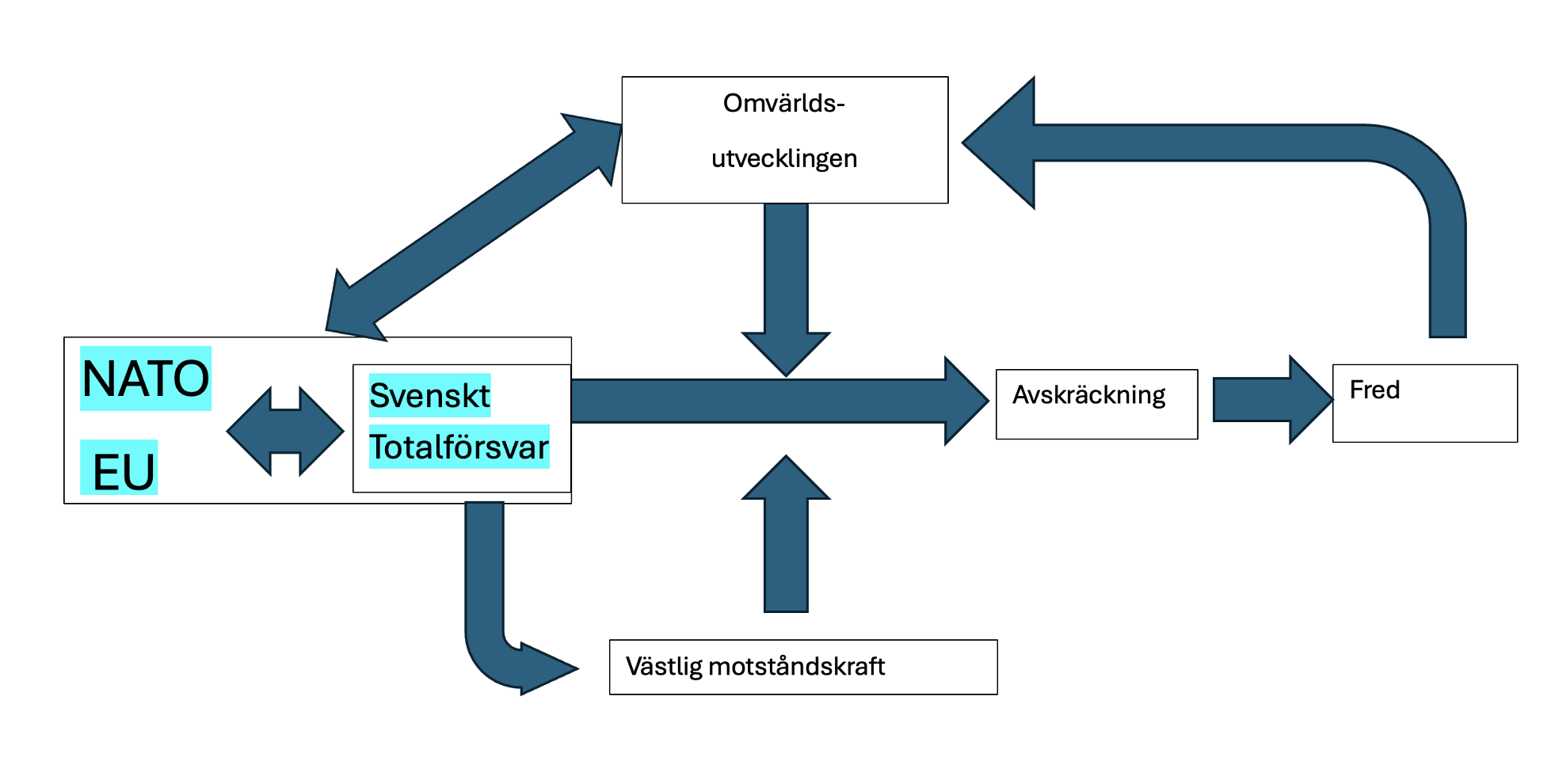
The purpose of the SV-AR project is illustrated by the abbreviation, where SV stands for Sweden, A for deterrence and R for Resilience. The dashes symbolize the need for endurance over time and thematic synergy in the spectrum from peace to war.
Sweden is a member of both NATO and the EU, and the analysis of Swedish total defense must now increasingly take this larger context into account.
NATO and the EU can and should influence global developments in a positive way, and Sweden, as a member, should have an ambitious policy for decisions to be made about this.
At the same time, NATO and perhaps especially the EU have opportunities to help strengthen Sweden and the Western world's resilience.
Both external developments (positive and negative) and resilience, together with the total defense in Sweden and NATO, affect the conditions for deterrence.
This in turn – in the situation the world finds itself in – is a prerequisite for preventing war, what peace researchers have sometimes called negative peace: the absence of conflict. It is not an ideal state (positive peace with globally improved living conditions) but very much enough in the current situation in the world.
In Swedish defense policy debate, it is often argued that Sweden must focus on the immediate area and on the defense of Sweden, which, in cooperation with others, is required by Article 3 of the NATO Treaty. At the same time, Sweden must see the whole picture, namely that NATO and the EU also have wider interests that affect the requirements for Swedish total defense.
In the project's feasibility study, published in May 2024, we focused on Sweden's entry into NATO after a protracted accession process and Sweden's continued membership in the EU, as well as the opportunities that these multilateral collaborations could create. At the same time, we were able to assume a strong domestic political consensus that the Swedish total defense must be strengthened above the 2% level.
We wrote in the preliminary study that:
"The world is already facing significant risks of a serious war this year. This is mainly due to the development of Russia's full-scale war against Ukraine, but also to the explosive situation in the Middle East created by Israel's retaliatory war against Hamas in Gaza and the West Bank. To deal with these crises, a functioning and responsible United States is required. Therefore, the domestic political situation in the United States ahead of this year's presidential election is very worrying. At the same time, the parliamentary elections in Taiwan remind us of the risks of war that exist in Southeast Asia in the slightly longer term, given China's political and military ambitions."
It can be stated that the situation with regard to these war and war-threatening front sections has subsequently developed dramatically in a negative direction.
It is often argued that, over time, states' security policies converge on the generally perceived national interest and a fundamental respect for international commitments. In both democracies and dictatorships, policies vary over time, but diplomatic reporters are often trained in the art of seeing the big, unchanging contexts.
It is particularly risky at a time when the risks to global, regional and national system collapses and devastating disasters – partial or multi-sectoral – appears larger than in a very long time
- with weapons of mass destruction,
- climate change,
- internationally threatened – and threatening – flows including pandemics
- and regional wars, etc.,
while international geopolitical tensions have gradually eroded in terms of
- treaties and other agreements on arms control
- crisis management mechanisms
- institutional mechanisms for the peaceful settlement of disputes, including in the nuclear field,
- and internationally established and respected standard-setting.
At the same time, dramatically increased complexity in decision-making and speed in information flows are placing increasing demands on leaders in both large and small countries. This increases the stakes when leaders in major powers try to achieve radical changes in previous policies.
At the same time, it may be precisely necessary for peace and the economies of countries to powerful multilateral proposals is being put forward to deal with major threats and challenges. This is not least the case in a situation where several wars are ongoing in Ukraine and the Middle East and when another major conflict between China, Taiwan and the United States threatens.
II. External developments
When this report is finalized at the turn of the year 2024/25, Donald J Trump will have won a landslide victory in the US presidential election. He will now take over the leadership of the world's leading superpower with:
- a clear popular mandate for his political program announced in the election campaign through the surprising preponderance of the total vote and the clear victory in the presidential election itself,
- majority for the Republican Party (GOP) now completely dominated by him in both chambers of Congress,
- thereby strong support for the president's appointment power,
- The Supreme Court's ruling on presidential immunity and other signs of the weakening of the judiciary in relation to the executive branch, and, through
- the media's generally weakened role as a controlling force.
Donald Trump has quickly nominated key players in his administration, with an emphasis on loyalty. At the time of writing, a tug-of-war is looming between the incoming White House and GOP senators in the process of confirming his, in a number of cases, startling appointments.
Progressively less freedom of action for Trump?
How can Trump and his now well-prepared team and support troops use the power they have been given by the American voters? Does the impression of unlimited power only apply until the time before the next mid-term elections, in 2026, after which new political processes (and public sentiment) can be expected to grow in strength and Trump's position/image as "lame duck"before the end of his last term can begin to dominate? For Trump, it will be important at that stage, one can assume, that his policies can be credibly described as successful.
It is also possible that Trump will retain his leading position for the rest of his presidential term and then be replaced by Vice President Vance, who will then have the opportunity to continue Trump's policies for a maximum of another eight years.
Trump now takes over the main responsibility for the United States in a world that is in essential respects different from that under "Trump 1.0". This is happening at the same time as it is realized that his policies, as announced and presented so far, risk making the world even more different, even more dangerous. For Team Trump, as was the case for the outgoing Team Biden, crisis management in Ukraine, the Middle East and Southeast Asia can be expected to be at the center. Added to this, for the Trump administration, are the revolutionary plans that are announced to, in the near future and fundamentally, change the character of American society (including immigration policy) and the American rule of law.
Trump has long developed a strategy that is primarily based on bilateraldealmaking" that surrounds various multilateral arrangements. He has shown himself prepared, when necessary, to question or disregard existing political and international legal commitments. America's interests are then put first, and the importance of solidarity with allies and other allies is given a lower status.
From the day he takes office on January 21, 2025, Trump is expected to issue a number of so-called “executive orders"which partly repeals decisions made by President Biden (corresponding to the "restorers" that Biden decreed in 2021), and partly also otherwise goes beyond and modifies what the previous administration's policy included. This will increase uncertainty in the outside world regarding the continuity of American security policy.
Here is the power to change most clearly linked to the ability to prevent business from continuingNegotiations take longer, and so does building capacity. Experts with experience of previous attempts – for example under Secretary of Defense Rumsfeld – also warn against overconfidence in the possibilities of influencing the habitual behaviors of civilian and military bureaucracies.
Already in his second year, the president must do his best to maintain control of Congress ahead of the mid-term elections at the end of 2026. We assume that this may involve a certain return to a focus on traditional American interests in order to win over broader voter groups and face opposition from a then powerfully mobilized Democratic Party. In addition,
- the demand from American voters for positive economic development with limited inflation, and
- the need to demonstrate both security policy strength and that he can contribute to positive developments in the world under the motto "peace president" that he has already expressed. Strong forces in his own party define this motto based on the requirement to be able to negotiate from a position of strength and to be prepared to deter in a credible way.
- To this should then be added that among the “megatrends” that characterize the global scene in today's world, thus in addition to the threats from climate change, pandemics, mass migration, terrorism, etc. Here there are challenges that should promote global cooperation, but which can also lead to conflicts. Here is also found what can be called the “globalization of security policy”, i.e. the tendency to interconnect the different sub-conflicts of the global scene, both in the East-West dimension and in the North-South dimension, “everything belongs together”. Various factors have contributed and interacted to this development that is important for Swedish and European security policy.
Like general globalization, for better or worse:
- technological development,
- multipolarization,
- the risk of nuclear proliferation,
- The declining but still dominant power of the United States, as well as
- the tug-of-war between revisionist and status quo forces in both the East-West and North-South dimensions (cf. e.g. “global south”), etc.
This means that:
- “World War III” could start anywhere, intentionally or unintentionally (Taiwan, Moldova, the Baltics, the Middle East…?),
- Even conflicts “far away” can pose a concrete risk of war, even beyond what would follow from NATO solidarity with a USA (even a Trump-USA) that is struggling with security interests and commitments in other parts of the world.
This further means that it will be in the Swedish (and European) security interest to actively contribute, to the extent possible, to mitigating conflicts and the spread of conflict even far beyond the immediate area.
Trump's USA: hardly "business as usual"

Photo: Shutterstock
What the Trump administration now, as during the campaign, says it wants to achieve, has been described as a state of emergency. A state that is a coveted opportunity for one half of the United States and a serious threat to the other. And it concerns both domestic policy and foreign policy, separately and together.
Donald Trump has already shown through his controversial appointments that he intends to actually implement the groundbreaking changes to the state and society in the United States that he promised in the election campaign.
Part of this is to search
- taking revenge on all sorts of adversaries during the Biden years,
- dramatically cut down the federal administrative apparatus,
- reshape the gigantic Pentagon and purge displeasing senior officers,
- reshape and subjugate the Department of Justice, and
- Urgently and dramatically implement a radical recast of American immigration policy, including “states of emergency,” mass deportations, and notices of the need for military support in their implementation.
What the latter will mean, indirectly and possibly directly, for migration pressure in Europe remains to be seen.
This alone guarantees that the domestic political scene in the United States in 2025 will be characterized by significant turbulence, with a kind of tug-of-war between the incoming, Trump-dominated regime's drive for rapid and dramatic implementation and everyone's experience that this kind of transformative change normally takes a very long time to put in place.
A question then inevitably arises. What consequences does this have for the foreign and security policy that the incoming Trump administration wants and can pursue? This concerns the balance between the critical crisis areas of Ukraine/Russia and the Middle East in the near future and the dominant threat from China in the long term, as well as the balance between goals (“America first", "peace", etc.) and means, such as alliance policy, NATO, nuclear weapons modernization, etc.
Global developments towards the end of 2024 were characterised by the expectations of interested parties that when Trump takes office this would entail some form of fundamental "game changer", aimed at paving the way for a ceasefire and a peaceful resolution to this devastating conflict. However, no one, certainly not Trump himself, takes Trump's earlier claim that he could create peace between Russia and Ukraine in 24 hours seriously anymore.
- Hence the feverish effort of various actors to advance the front and position themselves for this expected new situation, and the fears of Ukraine and its European partners that a “deal” initiated by Trump would force Zelinsky's Ukraine into a peace process largely on Putin's terms.
- Hence the clear tendency towards military escalation at the end of 2024, but also the trend that the international conversation has now been modified to talk more about support for Ukraine's future position in negotiations than about the unacceptable nature of any outcome other than Ukraine's total victory, and Russia's clear loss.
It was obvious by the end of 2024 that this dramatically uncertain situation ahead of the clarification of Donald Trump's intentions was having a severe impact on the European arena's deliberations on key security issues. This applies to both NATO and the EU under new leadership, as well as transatlantic cohesion.
An important question was whether Trump's assumption of power, as feared, would lead to a clear reduction in American commitment to support Ukraine's existential defense struggle, and would European countries then be capable and prepared to fill the void left by the American retreat within a reasonable time?
It was also obvious before the change of power that Donald Trump's election victory, even in addition to the central Ukraine factor, could have a noticeable, and from a liberal-democratic point of view worrying, impact on domestic political conditions in Europe and on the EU institutions. This is against the background of the stimulus that the Trump victory and the rise of the MAGA movement are expected to give, especially to right-wing but also left-wing extremist forces in important European countries – forces that can now challenge parties and coalitions that in the post-war period have carried stability and developed prosperity on this side of the Atlantic. In European politics, before the turn of the year, it was mainly about the parliamentary instability that has arisen in the European superpowers Germany and France, the divergent stance at government level in countries such as Hungary and Slovakia, and the progress of the far right in the European elections in the summer of 2024.
The risks of global system collapse(s) and related war risks

The latest developments in South Korea and Syria are a reminder of the volatility of the global situation in general and the need to be on guard, both analytically and politically, for sudden changes in the scene and patchwork. This perspective is strongly reinforced if the overall picture also includes the turbulent situation before the end of the year in the world dominant USA and the explosive situation in the Middle East, including Syria.
It is thus a matter of what could be called a “sham development of the external world”, given the combination of negative factors above, and precisely the factor of the absence – as a trend and fact – of functioning mechanisms for mitigating conflicts and solving problems. That the war in Ukraine in particular, its risks of escalation and difficulty in resolving, is central in this regard is obvious, as is the uncertainty factor regarding the intentions and capabilities of the Trump administration. But the risk picture under this heading is broader than that.
Western countries, of course including Sweden, have long spoken of "a rules-based world order" and a "European security architecture", which is partly a creation of the victorious powers in World War II together, and partly, essentially, of the Western powers through victory in the Cold War.
If these rules and this institutionalized order, increasingly clear and increasingly unblemished, prove not to be accepted and respected by counterparties as "Global East” respectively, in the more difficult case, ”global south"the world has de facto been deprived of common rules of the game and a common system of norms, which during the post-war period have been more equal and the basis for peaceful resolution of disputes. If we add to this the absence of a functioning UN Security Council with reduced power of action (also in other UN institutions), a functioning Euro/transatlantic forum such as the OSCE, and the fact that the last forum for talks between the US and Russia on arms control in the nuclear weapons area (New Start) risks not being extended from 2026, while the risk of nuclear proliferation remains at its highest level, a picture emerges of a global system in disarray, a dysfunctional system. This is both as a result of the rapid progress and as a result of the trend towards the disappearance of common rules of the game. A collapse of the system with difficult-to-assess consequences cannot therefore be ruled out, also in terms of the spread of conflict and the risk of war, intentional or unintentional, even for Sweden.
Against this risk stand those forces and interests that, even in an "irregular" and "supposed" global scenario, have the will and ability to work towards restoring strategic stability and at least minimal cooperation; concerning the fear of nuclear war and the climate threat, the need for functioning world trade, economic self-interest, etc.
The war in Ukraine is a defining moment for the Swedish total defense

The defining threat to total defense is constituted by a Russia with unbroken imperial ambitions. The war in Ukraine is an important factor in assessing how urgent the threat may be. Hence the significance of the American presidential election and the question of whether the Trump administration's Ukraine and Russia policy, still unclear in its contours, will entail a winding down/reduction of the Biden administration's relatively wholehearted military and economic support for Zelinsky's Ukraine.
It remains the case – but more on this below – that Ukraine's allies in the West have fundamentally and essentially been and are faced with a demanding choice between three main strategic alternatives:
- Reduce support and risk Ukraine losing and Russia actually winning in the end (regardless of definition) – with the security policy consequences this would entail for Europe, and the world,
- or maintain the support (and restrictions) much as before – and risk a protracted multi-year or multi-year war of attrition with great suffering for the Ukrainian people,
- or greatly increase support to enable a decisive Ukrainian front advance (“victory”, or at least a significantly strengthened negotiating situation) – with the inherent problem of assessing to what extent Putin’s threat to radically escalate the conflict in such a situation should be taken seriously. Right now we are seeing increased international interest in starting to explore the possibilities of negotiations for a ceasefire and peace after all. This brings us closer to the question of whether Russia will ultimately be perceived as having been rewarded for its war of aggression. It is obvious that Western security guarantees, as the example of the “Budapest Memorandum” from 1994 illustrates, in the future risk being viewed with great skepticism by other states that currently rely on US support and American deterrence for their security.
The Russian war of aggression against Ukraine passed its 2024-day mark in late autumn 1000 and is entering its third winter of war, compared to the week or so that Vladimir Putin probably thought and planned for when he launched his so-called special operation. The Ukrainian resistance has – with growing Western support – thus demonstrated extraordinary endurance. At the same time, the war has entered its third winter of war with persistent Russian bombardment of critical Ukrainian infrastructure and energy supplies – as well as terrorist bombings targeting the civilian population similar to those carried out during World War II.
On the 1000th day of the war, there was an escalation through Biden's belated decision to allow Ukraine to use the long-range ATACMS missile deep (max. 300 km) into Russian territory – and the Ukrainian army's immediate use of this capability. President Putin responded immediately by signing a tightened doctrine for the use of nuclear weapons. It includes that nuclear weapons can be used even in the event of an attack by a non-nuclear-weapon state (read: Ukraine) that is actively supported by a nuclear-weapon power (read: the USA, but also France and the UK). The USA has thus crossed several Russian red lines if one includes the simultaneous decision to provide an additional military aid package of 275 billion USD, while the Russian leader presents the actual situation as casus belli for the use of nuclear weapons.
The Biden administration's decision must be seen in light of
- of the Russian side's supply to the Kursk front of more than 10 North Korean troops and the horizontal expansion and escalation of the conflict that this entails,
- of the Ukrainian side's obviously failing military capacity to hold positions in Donbass but also in the Kursk area.
The temptation to declare this situation as an acute risk of direct conflict between the US/NATO and Russia (with allies of various kinds and degrees) is reasonably dampened by the now almost three years of experience of rhetoric linked to nuclear threats and power jumps across Russian red lines and the accompanying reduction in credibility.
Ukrainian resistance, military and social, together with Western support and collective Western deterrence, has managed to withstand a constant Russian onslaught, by land, sea and air, for more than 1000 days, so that in practice a kind of war of attrition has arisen without significant shifts in the front line that emerged in the early stages of the war after initial Russian successes. One could also use the word war of attrition, considering the extraordinary Russian losses in soldiers and materiel, but also everything that the brutal war has cost the Ukrainian nation in military and civilian casualties, in material and infrastructural destruction, etc.
The almost three years of war have largely been about a endurance duel and one deterrence duel, partly between Russia and Ukraine bilaterally, and partly between these countries with the support of other countries. Russia has since been supported to varying degrees by partners such as China, Iran and North Korea, and Ukraine by the US/NATO/"the West".
The duel of endurance has been about, on the one hand, Ukrainian resilience and the willingness and ability of the West to support it sustainably. All this is set against the persistence of the Russian ability to switch to a war economy and war production, find alternative disposals for its oil and gas assets, and reduce the impact of Western sanctions of various kinds.
The deterrence duel, on the other hand, is a three-year history of mutual efforts to achieve deterrence. On the Russian side, this has been manifested primarily in recurring threats of nuclear weapons use (see above) and various red lines to slow down or prevent the increase in Western support efforts, qualitatively and quantitatively. On the Western side, there was first the failed attempt to deter Russia from attacking Ukraine, then the (so far, successful) effort to strengthen military strength and readiness along NATO's eastern flank to deter Russia (and Belarus) from any form of military attack on the territory of NATO countries. Since then, there have been power jumps over a series of feared or stated Russian red lines concerning various weapons systems, most recently ATACMS (and British Storm Shadow) and anti-personnel landmines. In these cases, it is rather a question of defying or ignoring Russian deterrence. Pending, therefore, an escalation effect as a result of Russian willingness and ability to respond/retaliate to this step.
It later turned out that the Russian response, in addition to general rhetorical threats, would specifically involve partly a demonstration, in Dnipro, of a new hypersonic, long-range and nuclear-capable missile, “Oreshnik”, with multiple-warhead warheads (“MIRV”), and partly a general escalation of the air war over Ukraine and of the ground offensive both along the long front in Ukraine and against Ukrainian positions in the Kursk area captured by Ukraine inside Russia.
The end of the war is therefore now seen on the Western side more in terms of a strengthened Ukrainian negotiating position ahead of negotiations than a "total victory".
In anticipation of President-elect Trump announcing his intentions and (possible) planning, a number of the actors mentioned see themselves forced to exploit the void and uncertainty by attempting to advance their positions, which in themselves are potentially destabilizing.
On the Russian side, a general intensification of warfare was observed, on various levels, in parallel with relatively clear indications of interest from Putin and the Kremlin in holding talks with the incoming Trump and his administration. This could be seen as a kind of response to Trump's various statements about the importance of a peace agreement and his explicit criticism of the outgoing Biden administration's decision to allow the use of American (and thus Western) long-range missiles by the Ukrainian side against targets on Russian territory.
At the same time, on the Western side, it has essentially been about what has been called "Trump-proofing", i.e. the effort in various areas and levels to ensure, through rapid support decisions, that a kind of fait accompli is created before the change of power in the US, i.e. to tie up maximum levels of support in support of the Ukrainian defensive war and thus mitigate the effects of a possible/feared more or less radical change of course from the change of power on January 20, 2025.
This Western work has taken place and is taking place at three levels of actors:
- Partly It has been about the outgoing Biden administration's forced work to translate into concrete action packages - on time - the support volumes that have already been decided by the divided Congress, albeit after a long delay, all the while with uncertainty about whether this has happened with the incoming Trump administration's understanding and willingness to follow through.
- Partly There have been accelerated decisions within NATO and the EU – most recently at the EU summit in mid-December – to ensure maximum political freedom of action regarding support for Ukraine, including the clearest possible signals on the delicate issue of enlargement, EU and NATO respectively.
- Oh partly European NATO and the Biden administration have agreed that the operational management of military support to Ukraine (Ramstein) is now handled by NATO, not the United States.
In addition to this, there are corresponding support decisions at national levels. For Sweden, the defense decision has been about the delicate balance between Swedish defense needs and bilateral military and civilian support for Ukraine's defense struggle.
The Western work has had to be carried out in a sensitive situation vis-à-vis a Trump administration whose return to the White House, with clear support in Congress, has evolved over the year. From something hypothetical to something entirely possible to (after the election) something certain, with a concomitant increase in the pressure to manage the transition with the greatest possible openness and coordination with the incoming team. This has been a delicate balancing act, not least for President Zelinsky.
The year 2024 has thus resulted in major question marks regarding the continued development of Russia's catastrophic war against Ukraine. Will it be:
- continued escalation (horizontal and/or vertical),
- or prolonged freezing
- or some kind of change of course in the direction of negotiations.
It has long been clear that in one scenario the consequence of the power shift will be a clear reduction in American support, relatively immediately or in the longer term. The challenge for European policy will then be to mobilize the economic will and ability to compensate for the American loss. This is a necessity if a final Russian victory is to be prevented, with extraordinarily serious consequences for European security.
Preparedness to deal with such an extremely demanding situation must be created and maintained in Europe. There is now broad consensus on this, also if an incoming Trump administration were to take a long time, perhaps a year or more, to give a final statement on how and where they stand on this fateful issue. A delay that may be a result of all sorts of distractions in other parts of the world and/or at home, or as a result of all sorts of negotiating moves.
This is one scenario, there are more. Another is the possibility that Trump surprises the world by taking a clear stance on Ukraine's defense, even if the stance is fundamentally about a negotiating approach, perhaps with a high degree of risk-taking.
Overall, 2025 can hardly avoid being a dramatic year for Swedish, European and even global security, where the Ukraine issue is central.
The Middle East

Even in the brutal war in The Middle East between Israel and partly Hamas in Gaza, partly Shia Muslim Hezbollah in Lebanon, partly the Houthis in Yemen and various Shiite and Iran-backed militias in Syria and Iraq, partly the state of Iran itself – it is a conflict with a high risk of spreading regionally and potentially even globally.
Already in the situation that existed towards the end of 2024 in the region, there were clear connections to the global level. A situation that throughout the war year prompted a nervous American major effort to deter – primarily Iran – through a large-scale military presence, both in the eastern Mediterranean and the Persian Gulf and through special forces in sensitive land areas in Syria and Iraq. This mainly concerned the Yemeni Houthis' shelling of civilian shipping in the Red Sea – with Israel's attack on Hamas in Gaza as a pretext and with severe consequences for world trade as significant parts of global shipping were forced to avoid the shorter route through the Red Sea-Suez Canal and instead take the costly and time-consuming detour around Africa. This became a persistent problem, despite extensive American (and other) military counterattacks. The Houthis showed surprising endurance and (Iran-supplied) military capacity, primarily advanced drones.[5]
It also concerned the development of military cooperation between Russia and Iran, including Iranian deliveries to the Russian war in Ukraine of significant quantities of Shahed drones. Thus, there is a direct connection between the wars in the Middle East and Ukraine and a manifestation of the emerging cooperation between the countries of the axis of Russia, China, North Korea and Iran.
A further issue with global repercussions was the dramatic decision by the International Criminal Court (ICC) at the end of the year to indict and issue arrest warrants not only for Hamas leaders but also for Israeli Prime Minister Netanyahu and former Defense Minister Gallant. This entails an international legal obligation for the 124 signatories of the Rome Statute to arrest those designated during a visit to these countries. The decision, which in itself implies a rejection of Israel's own legal capacity (willingness and ability) to handle the matter internally, raises delicate questions regarding trust in and the strength of the principle of "a rules-based world order". Likewise, its handling in the upcoming diplomatic tug-of-war will be an important element in the geopolitical conflict structure of the coming years. For countries in the West, which, unlike the US and Israel, have actually signed the Rome Statute, it is also very much about "double standards"-dilemma, not least considering that Putin has also been branded by the ICC. To this should be added that Israel's warfare, first in Gaza but later also in Lebanon (and other places), is simultaneously being examined by the UN body ICJ, the International Court of Justice.
This – the risk of international pariah status – together with the component of ongoing arms deliveries, underlines Israel’s rapidly increasing dependence on US support. This in turn has heightened the issue’s significant sensitivity in American domestic politics, especially in an election campaign like the fall of 2024.
It should be recalled here that the broader, if not full-scale, regional conflict in the Middle East, right from the start on October 7, 2023, has basically been about the Gaza war and the international tug-of-war over a ceasefire. Houthis, Hezbollah and Iran-backed militias have consistently declared (and verified this during a shorter ceasefire in December 2023) that the fighting will end when there is a ceasefire. And much of both the fighting, in both Gaza and Lebanon, and the diplomacy surrounding it has been a question of the difficulty of achieving a ceasefire, as the start and starting point for a complicated further game of ending the war. A ending that forms the basis for necessary work to rescue affected civilians and to achieve an exchange between primarily Israeli hostages in Gaza and a number of Palestinian prisoners in Israeli prisons.
Despite significant American, Qatari, and Egyptian mediation efforts to achieve the desperately needed ceasefire, including a remarkable eleven visits to the region in this single year by Secretary of State Blinken, this crucial milestone had not yet been achieved by the end of 2024, to the near total frustration of all involved. However, see below on the ceasefire in Lebanon.
The reason for this can be said to have been basically twofold, firstly the incompatibility between the war goals of the warring parties – total victory for Netanyahu, the survival of the organization for Hamas, and secondly the Biden administration's gradually decreasing influence over Netanyahu's actions. Added to this was the difficulty in the election campaign at home of deviating in the slightest way from the main line of politically and militarily standing behind Israel, even an Israel under Netanyahu's leadership in an internationally controversial war, to say the least. A war that later developed further into Lebanon and the settlement with Israel's other enemy in the vicinity, Hezbollah – and the growing international questioning of what constitutes the right to self-defense and a just war. The figures for human losses and destroyed infrastructure in Gaza in particular are horrifying and shocking even Israel's friends in the world.
When Trump takes office, he is expected to pursue an even more pro-Israeli (and anti-Iranian, possibly also anti-Palestinian) policy, essentially a continuation of what was tried under “Trump 1.0.” This is welcomed by the survivalist Netanyahu, who is less interested in accommodating a departing Biden, despite the fact that he is widely considered internationally to be one of the most pro-Israeli US presidents in history.
Looking ahead to 2025, it is clear that Hamas' brutal attack on October 7, 2023, and Israel's subsequent massive and humanly devastating warfare have significantly changed the strategic balance in the always sensitive Middle East.
On the one hand The Israeli, consistently supported by the US, warfare has been successful, based on the declared war goals, by almost militarily crushing Hamas in Gaza, seemingly seriously reducing Hezbollah's military capabilities in Lebanon, restoring some deterrence against the Houthis in Yemen and the Shiite militias in Syria and Iraq, and, most importantly, seemingly (and with US backing) deterring Iran's embattled leadership from a long-awaited military retaliation. And this has been achieved without having to resort to the ultimate deterrent, nuclear weapons. Donald Trump may be looking forward to contributing to further measures and steps to secure the seemingly victorious Netanyahu's political survival, against all odds, including protests from hostage families and threats of accountability for the October 7, 2023 fiasco. Could this lead to Netanyahu, in order to strengthen his popularity, raising the issue of formally incorporating the West Bank into Israel?
The ceasefire agreement that was finally concluded at the end of November between the (extremely reluctant) parties in this latest Lebanese war through American/French mediation brought great humanitarian relief – and some hope that the Gaza crisis could finally land a similar agreement – but at the same time there was strong concern about compliance and implementation.
On the other hand There is everything to suggest continued drama in the Middle East, even for a President Trump who can be assumed to covet the honor of some kind of major, peace and stability settlement in the region as a whole, including Iran. The questions about what will happen next, in both Gaza and Lebanon (and in Israel), are gigantic in complexity and intractability. Answers are already missing when it comes to the question of the governance of Gaza after a final ceasefire and end to the war, and this involves both Israeli and international responses. The task of – finally – rescuing millions of Gazans who have been exposed to the face of war and starvation for more than a year is unprecedented. Comparisons are made with Dresden, Mosul and Groszny, but they are likely to be lame. And what will happen to the Palestinians in the West Bank? And how will the state of Lebanon, badly affected even before the war by years of disasters, be able to find some kind of stability and state normality, with or without a more or less defeated Hezbollah.
International diplomacy is now talking a lot about the necessity of starting a process, a credible process, towards a political solution despite all the obvious obstacles and difficulties. The solution that exists is only a two-state solution based on the Oslo Accords, which is also the view of the outgoing Biden administration. This now also requires the participation of neighboring Arab states, not least Saudi Arabia, whose physical participation in any form of normalization and reconstruction is seen as a prerequisite for minimal success. At the same time, Israel is making it increasingly clear, in words and actions, that it is now, if not sooner, time to put the two-state solution on the shelf of oblivion.
Then there is the variable of Iran and the mixed signals that are now emanating from Tehran, now under a president, Masoud Pezeshkian, who is squeezed between ayatollah rule and ICRG power language (and threats of tough action under Trump). He is trying to free his country from sanctions and the threat of sanctions and is indicating a willingness to de-escalate and engage in nuclear talks, but with the threat of retaliation maintained.
On November 27, 2024, the outside world was reached by news that the rebel groups – dominated by the “jihadist” Hayat Tahrir al-Sham (HTS) – who since 2016 have held out against the Russian-backed Assad regime’s repeated attacks in the province of Idlib in northwestern Syria under some Turkish protection, had carried out a lightning attack on the large city of Aleppo. In a short time, they had captured the city and moved further south, via Hama and Homs towards the capital Damascus. This was the start, and within just a couple of weeks of astonishingly rapid development, the HTS-led rebel uprising, in the face of a stunned world in the East and West, had led to the rapid victory of the Sunni rebels and the collapse and exodus of the Assad regime. Likewise, to the withdrawal of the supporting actors, Russia, Iran and the Lebanese Hezbollah – in other words, a total geopolitical reversal in a very short time. This is a new challenge for the outgoing Biden and incoming Trump administrations in an already tense regional context. In principle, it is a question of unfinished wars in Gaza and Lebanon and an unfinished course of tension between the region's military protagonists, Israel and Iran.
The collapse of the Assad regime has brought about another major change in the region's security structure and deterrence in a short period of time. The result has been joy for all the regime's victims at home and abroad, the weakened position of Iran (and Hezbollah, and other Iranian proxies in Syria and Iraq) and Russia in the region, and the astonishingly rapid, if uncertain, takeover of power by the Sunni Islamic armed forces. It is now possible to speak tentatively of the large and wounded Syria and its upcoming experiment in state and nation building as the holders of the key to further regional development. This was set in motion and on fire on October 7, 2023, with Israel and Turkey as the apparent net winners, for the time being. At the same time, the fall of the Assad regime means that there is a risk that European jihadists will now return to Europe to carry out new terrorist acts there.
All in all: even for an incoming President Trump, the Middle East will certainly be a powder keg – in addition to the powder keg that the region has always been – that raises big and serious questions about the nature and degree of American responsibility. Globally and historically, it is a question of a weakened US in terms of influence, which, however, risks being drawn more rather than less into a turbulent area where the parties seem to be striving for a kind of normalization. It is about Iran and Saudi Arabia, partly through proactive Chinese mediation, the US without and alongside Trump's previous diplomatic triumph, the Abraham Accords – which was basically about Sunni-Israeli normalization.
The continued development of the Middle East crisis is influenced by and affects the adjacent crisis area of the Horn of Africa, which in turn borders a devastating war in Sudan, among other international challenges.
A long-term risk of World War III: Southeast Asia/Taiwan

China's global expansion, especially at sea, is one of the most important trends of this century. It is about a dictatorship with great resources that is determined to regain the role of the Middle Kingdom in a global sense. The policy involves a long-term challenge to the US position as the global naval power. Whether it fails or succeeds, this will have important consequences – also for Europe and Sweden.
The fact that competition with the US is also largely virtual, encompassing a furiously rapid development of AI, further underlines the seriousness. The Trump administration faces an incredibly complicated task of navigating issues regarding the balancing of sanctions, tariffs, investment-related decisions, etc. How Europe behaves and acts in this positioning of the giants will be central not only for the EU but also to a large extent for the US, with its great need for allies in this area.
President Xi Jinping has stated that building a naval power “is of great and far-reaching significance for promoting sustainable and sound economic development, safeguarding national sovereignty, security and development interests, realizing the goal of completing the construction of a moderately prosperous society, and then realizing the great rejuvenation of the Chinese nation.” Furthermore, China’s 2015 military strategy states that: “The traditional mentality that land is heavier than sea must be abandoned, and great importance must be attached to managing the seas and oceans and protecting maritime rights and interests.” This is somewhat ironic because Chinese policy is precisely restricting freedom at sea.
The Chinese goal is being translated into an unprecedented rearmament of the Chinese navy. This is already the world's largest, although it cannot yet compete qualitatively with the American one. New ships are being launched at a rapid pace. Alongside the navy, there is the world's largest coast guard and a maritime militia with "militarized fishing vessels", a kind of aggressive naval home defense.
China is also increasingly active in the Arctic. Five new icebreakers are currently under construction. The strategic goal here is stated as “To develop the Arctic, China will improve the capacity and ability to use applied Arctic technology, strengthen technological innovation, environmental protection, resource utilization and development of shipping routes in the Arctic, and contribute to the economic and social development of the Arctic, improve the living conditions of local people and strive for common development.” However, exactly how the Swedish and Norwegian populations north of the Arctic Circle will benefit from China’s expansion is unclear.
In recent years, China's navy has also been active in the Atlantic, Mediterranean and Baltic Seas. China is striving to truly create a Middle Kingdom where surrounding countries are some form of vassals. The Belt and Road Initiative or One Belt One Road (OBOR) is an important instrument. Chinese interests have made major investments in important ports such as Hamburg and Piraeus. In other places such as Colombo (Sri Lanka), ports are now controlled by Chinese interests. On the surface, this concerns civilian economic interests, but it is obvious that a civilian port can also relatively easily become a naval base. The Chinese push regarding Lysekil 2018 – “Kinekyl” – should probably be seen against this background. With its increasing presence in European waters and in the Atlantic, China needs a naval base on the European side of the Asian mainland.
The Taiwan issue should be seen in this light.
Regardless of Donald Trump's "window of opportunity" in the coming year as stated above, it can be stated that his full term of office covers the critical year in Southeast Asia and the world at large, 2027. This is the year when China's strongman and president Xi Jinping has ordered China's rapidly growing military to stand ready with the military capacity to (be able to) conquer Taiwan. The Taiwan issue thus has every possibility of developing into the largest and most globally dominant security challenge during Trump's term of office, almost regardless of the development of the wars in Ukraine and the Middle East.
The background to this is that the Taiwan issue already constitutes a challenging tactical and strategic dilemma for the United States. At the same time, China's military (and political) growth in power in a multipolarized global context poses a growing threat to the United States' regional allies, Japan, South Korea, the Philippines and Australia, countries that are also threatened by North Korea's aggressive rhetoric, advanced nuclear ambitions and the now initiated defense cooperation with Russia in the war against Ukraine. These four countries have therefore reacted in recent years not least by a strong military buildup and by intensified defense policy cooperation with each other - and with the ally the United States. It can thus be stated that the region is characterized by a clear escalation and a rapid dynamic, with serious global security implications.
In this environment, it is a possibility bordering on probability that it is precisely the dynamics of the Taiwan issue itself, ahead of the “fatal year” of 2027 or before, that represents the igniting spark and the great risk of war. But on a global level, the China-US relationship is about a continued – security policy ambivalent – balancing act between the interest of mutual economic dependence in (admittedly minimal) cooperation and the risk and temptation of military and geopolitical competition, even armed conflict, a conflict with nuclear consequences.
During the Biden administration, the Taiwan issue experienced a significant, if perhaps not dramatic, escalation. It was a process of action-reaction, containing partly the focus on strengthening alliances and military rearmament by and with allies, partly a tendency towards a shift in American policy, including through former Speaker Nancy Pelosi's visit and Joe Biden's "yes" answer to a question about whether the United States intends to defend Taiwan in the event of a Chinese attack. Lai Ching-te's election victory and his more unblossomed independence rhetoric were also part of this process. The result was clearly escalated Chinese military-political reactions to all American and Taiwanese signals with what could be interpreted as questioning the hitherto prevailing, but over time increasingly refined, American "One China"-policy.
The degree of escalation that this involved overall highlighted the American dilemma: how, and for how long (before 2027), to maintain the current “strategic ambiguity” – to assist Taiwan with relevant defense capabilities. At the same time, postponing for as long as possible a clear answer to the question of how the United States will react to a Chinese attack on the island, regardless of the form of the attack in time and space.
The Taiwanese population, divided between advocates of anti-Chinese defiance and those who fear Chinese wrath and doubt American willingness and ability to provide relevant support, is meanwhile exposed to an intensifying Chinese hybrid warfare.
Another factor that must be considered when analyzing a potential conflict involving Taiwan is the global consequences linked to AI competition that interrupted deliveries of semiconductors from TSMC (Taiwan Semiconductor Manufacturing Company). TSMC currently accounts for around 50% of the world's chip needs and 90% of the most advanced chips. Most companies that depend on chips in their products: manufacturers of mobile phones, cars, computers, thermometers, stoves, grenades, etc. would have extreme problems maintaining their production. A longer interruption in chip deliveries from Taiwan would likely have major repercussions on the world economy. It should be noted here that China is also heavily dependent on imported Taiwanese chips for its industry.
If we add to this the separate and peculiar North Korea factor, the picture emerges of a security policy/geopolitical arena occupied by an almost extremely risky dynamic. And great uncertainty also for the near future. A sure forecast of the coming development is lacking. However, powerful elements of war of nerves will certainly dominate the picture, as will multiple examples of processes of mutual deterrence and a duel between deterrence and resilience, at different levels.
Donald Trump thus inherits a complicated policy area from his predecessor Biden, whose policy – despite Ukraine and the Middle East – has signaled a prioritization of this arena. A policy that has reaped significant successes in the area of alliance strengthening (and, indirectly, consolidating the NPT regime, given Japanese and South Korean temptations), but nevertheless a policy area filled with challenging policy considerations and dilemmas.
This means that in this area too, the world is now, not without concern, awaiting the answer to the question of what strategy and tactics a Trump and his incoming administration should have in this conflict-ridden, albeit not directly war-torn, region. The basis for the outside world's assessments and guesses is partly the experiences from "Trump 1.0", partly what has been ascertained from and interpreted in this year's election campaign. Minnesgoda recalls from the 2016-20 term of office, on the one hand, mixed and contradictory episodes of personal meetings with Xi Jinping in Mar-A-Lago and Kim Yong-un at the ceasefire line and in Vietnam, and on the other hand, hawkish talk about "the Chinese pandemic"respectively"fire and fury". But judging from what was said in the election campaign and the choice of collaborators (not least Secretary of State Marco Rubio), under "Trump 2.0" a further hardening of American China and Southeast Asia policy is imminent. However, there is great hesitation with great hesitation regarding the alliance political part of such a policy. This applies to conditional payment demands or commitment and solidarity. These are probably questions that are being pondered in Seoul, Tokyo, Manila and Canberra as well as in and Delhi.
But what does MAGA and “America first” policy mean for Taiwan’s troubled population? A clear answer is awaited, but the signals from the American election campaign have been ominous overall. It has sounded, and has apparently been interpreted by Taiwanese, as indicating challenging, not to say dangerous, times ahead. The fact that Trump criticized Biden for answering yes to the question of whether the United States intends to militarily defend Taiwan in the event of a possible Chinese attack – a statement that Biden’s associates later toned down – is one thing. One can speak here of a clarification and restoration of a classic, classically ambiguous, American line, but it is taking place in a new context of an escalating dilemma. In this context, it seems obvious that the ongoing dynamics bilaterally between China and Taiwan and in the wider region will deepen and complicate the American dilemma, or the balancing act. And Trump’s election campaign signals, incidentally similar to those directed at Europe, that Taiwan cannot expect a “freeride"and generous and unconditional American support seems to indicate a heightened situation in a particularly sensitive region."
As far as the Southeast Asian arena. There are connections, as we have noted, to Europe's proximity through the cooperation, at different levels and in different formats, between China and Russia and between North Korea and Russia. In both cases, moreover, through the involvement of American security policy, uncertain connections – as a result of the Trump factor, as in the Middle East.
III. The Western World's SV-AR
The Western world's response to challenges and threats
In the following, we assume that the new US administration will try to focus primarily on China. The task is so great in the medium and especially in the longer term that it requires cooperation between the US and like-minded countries, within and outside NATO. The focus on China leads to the allocation of more limited US resources to Ukraine and to Israel being given maximum freedom of action in the Middle East, while a further escalation and expansion of the war towards Iran is avoided as far as possible.
The Russian full-scale invasion of Ukraine on February 24, 2022 has provoked a reaction in the West that has so far deterred Moscow from further military aggression against NATO.
Here, Sweden's and Finland's accession to NATO and the decision to allocate large additional resources to total defense are an important and, for Russia, counterproductive development.
Perhaps most striking is the development in Poland, which, with great domestic political unity, despite sharp polarization in other respects, has allocated more than 4% of GDP to defense and has a significant American troop presence on its own territory.
The Polish shift in position from a desired level of 2% to 3% and perhaps 4% within NATO as a whole may well be embraced by the American president. It cannot be ruled out that he will pronounce such a level as a prerequisite for future American alliance solidarity.
What in the West has been perceived as Russian progress in Ukraine through the annexation of Crimea and parts of the Donbass region in 2014 cannot obscure the fact that Russia, through the Maidan events that same year, lost the opportunity to influence the development of control over a central part of the former Soviet empire through a pro-Russian president. Now Moscow is seeing that – despite all attempts at influence – the Moldovan people are also voting – albeit with a narrow majority – for accession to the EU.
The question then is how deterrence will be affected by Trump's return to power. He will initially be forced to deal with a complicated interaction between conventional operations and nuclear threats as a follow-up to the escalation described in the external environment section above.
Support for Ukraine – deterrence and resilience from a Russian perspective
The most immediate issue for Sweden is US support for Ukraine, where the president has unlimited power to immediately end all ongoing activities in support of Ukraine and generally reduce the areas of conflict with Russia.
To be able to do this, he must credibly communicate his intention to react forcefully to Russian attempts to move further west. Against this background, President Trump will presumably try to put pressure on Russia to prevent such a scenario from becoming a reality. This includes demanding that Russia cease threatening to use nuclear weapons.
However, there are very high demands on Russia, which in Moscow can be perceived as creating uncertainty in its own country about the way forward. Such uncertainty can be thought to undermine the stability of the Russian regime. This is based on extensive repression, disinformation and rapid capacity building in a war economy where iron-fisted discipline is maintained with the help of a strong enemy image. If the image of the enemy changes, this could affect the conditions for maintaining momentum in the war effort. This means that Putin must try to carefully calibrate how he wants to describe relations with the new American administration, which has already become clear in Russian comments before Trump's inauguration.
The American president's options for action are also limited if he sticks to the ambition that the United States should not become further militarily involved on the ground in Europe and that American costs in Ukraine should be limited as much as possible.
Trump also cannot be sure that it is enough for Putin to consolidate the territorial gains in Ukraine to date. For Putin, the historical loss is the lost opportunity to influence the development of Ukraine as a whole in 2014 and control over the Soviet empire in 1991. The threat perceived by Putin from the West and the South with color revolutions risks undermining the resilience and existence of the Russian regime. This Russian threat perception can only be influenced to some extent by the American president.
Putin may also conclude that what Trump can promise today may not last very long. He too sees with certainty that Trump has a window of time at his disposal, which prompts great Russian caution.
American dependence on Europe

Very soon, Trump may find himself dependent on cooperation with European states to create increased credibility in the American negotiating position towards Russia and, of course, China.
Two courses of action may then appear to be particularly important for the new Trump administration to consider.
- The first concerns what is perhaps perceived as the biggest threat in Russia – the expansion of NATO and the EU – something that in itself is both challenging and discouraging. Here, Trump can certainly speak out as an opponent of such an expansion, especially of NATO. But how can Putin know that this position will be maintained by future American administrations? To move forward on this point, agreements with influential European countries are required.
- The second concerns the possibility of further increasing the requirements for the share of gross domestic product that the allies must spend on defense – 3%, 4% or maybe even 5%? However, this requires negotiation, both bilaterally between the United States and various allies, and within NATO. Trump can tell Putin that he would prefer to refrain from such an increase, which risks making it difficult for Russia to maintain any form of parity in both nuclear and conventional weapons in the long term. At the same time, Putin will once again ask himself how this will be followed up in a situation where Trump can no longer control the situation.
In a situation where the US is showing a reduced interest in Europe, a number of European states may indeed consider it necessary to increase their military spending further. However, American influence over how these resources will be used, for example in the purchase of defence equipment from the US, may be limited by an unwillingness on the part of the US to confirm existing security guarantees within NATO. The willingness of European NATO members to militarily support the US “out of area” will also likely be affected.
An attempt by Trump to bilaterally negotiate peace in Ukraine could mean a freezing of conflicts without actual conflict resolutionFurther extensive negotiations with accompanying practical control measures will be required before it can be ensured that the ceasefire is not exploited by adversaries to build up additional capabilities and reallocate resources.
For Sweden, it is of particular importance if Russia is given the opportunity to rearm the Leningrad Military District, including Kaliningrad.
Possible consequence for Northern Europe: an increased military threat to Sweden
Overall, American options for action appear to be very limited in the near future without additional support for Ukraine.
Against this background, Sweden should make the worst-case assumption that the coming years will mean an improved Russian force position that could lead to increased military threats, or in the worst case, acts of war, against NATO and Sweden within a year or so.
It may take a long time for Europe and NATO to regain lost ground both figuratively and literally after such a catastrophic development, if it is even possible at all.
Threats to societal resilience – state of emergency in East and West?
During the years 2022 to 2024, it was possible for Sweden to achieve significant progress on the path towards closer community with like-minded people in the West through membership in NATO and bilateral agreements with the United States and other key Western partners. The rapprochement was largely based on a consensus in Sweden not only on support for Ukraine but also, on a broader level, on a value-based sense of belonging in relation to the entire West, and ultimately because of the obvious threat posed by Russia. The trend was described in the final security policy report from the SES project[6] at the turn of the year 21/22 in the following way:
"Sweden has no other alternative for the foreseeable future than to define itself much more clearly than it has so far as part of the de facto mainly Western community of values that adheres to the principles of democracy, human rights and the rule of law. This also applies at the global level. We must also prepare ourselves for the possibility that the political conditions for transatlantic cooperation could once again deteriorate dramatically - in light of ongoing global developments. It is now important to use the time available to permanently deepen this cooperation as far as possible through long-term and legally binding agreements. This is also part of the picture when decision-making systems at the international level are discussed. It is particularly significant from a Swedish military perspective."
The question that many Swedes hoped they would never have to ask again after the end of the Cold War is now back on the table. Is there, in fact, a sustainable Western community of values that survives external pressure and power shifts in many of the Western states that are important for Swedish security? Or is Sweden now experiencing a transition from a community of values to a more complicated geography of sometimes common and sometimes divergent interests within and between different actors in the West and in the rest of the world? Two possible developments appear at a crossroads. Either that the direction of global developments with a sustained offensive by more and more increasingly clearly authoritarian states, and perhaps coalitions of these, pushes for increased cohesion between states that identify themselves as liberal democracies (“we in the West”), or that this global trend, on the contrary, forces division and ideological confusion in the West (very much depending on developments in the USA).
Previously, we assumed that the foundation of our security was built on Sweden as part of a Western community of values when it comes to democracy, human rights and the principles of the rule of law. Now it is not only states at war that are well on their way to a martial When it comes to these principles, it can also happen in several countries in the West.
Russia's failure to initially invade all of Ukraine has thus led to what can be called a state of emergency without a declaration of war. A large-scale and brutal war was dubbed a special operation, which threw out many constitutional obstacles in Russia. At the same time, the introduction of a war economy was carried out with great force, in which many normal routines were thrown out of play and human lives were sacrificed on a large scale.
In parallel, China's policies have developed in a way that creates increased threat perceptions in the West. North Korea and Iran are now siding with Russia in a way that threatens both external and internal security in Europe.
What we are seeing now on the west side is a development towards what in some respects could also be called a martial, or at least a considerable strengthening of the executive branch. The development is led by the United States, where a president, Donald J. Trump, has been elected with full control of both houses of Congress and good prospects of further influencing the composition of the Supreme Court in the direction of greater freedom of action for the president. It must be considered remarkable that the combined expertise in opinion polls in the United States failed to forecast what ultimately became a convincing victory for Trump's line.
Even before the president took office, as mentioned, he has signaled what many will perceive as an end to "not least in terms of proposals for higher appointments."business as usual” in Washington. The president intends to deal with efficiency problems in the American administration, including the American military, with great force. In this context, he will not hesitate to override the decisions of previous administrations that the United States should work for a number of environmental and other requirements. The intention to reduce the number of officials at various levels and perhaps also close down a number of agencies and even departments is not entirely new in American politics when a new administration takes office. But the power of this ambition combined with the freedom of action that the incoming American president has is exceptional. At the same time, it is known that when large bureaucracies are shaken up and reorganized, it takes time for the system to function effectively again, sometimes years. This is a threat to Trump’s aforementioned time window.
In addition, this in Europe will likely lead to correspondingly extensive demands in a number of countries, perhaps also in Sweden. This too could in the short term undermine the order in the democratic political system of the West. In the longer term, however, the effects may be positive to some extent. The pandemic increased decision-making capacity in many countries in the West and made citizens aware of the need to act in a crisis under conditions that overrode normal bureaucratic principles. The question is whether it led to a general realization of the need for increased action or whether it will be considered a one-off event.
At the same time, it is clear that the decision-making complexity and speed of AI development in general require more efficient decision-making and implementation systems, especially in democratic countries. Patience with lengthy multilateral negotiation processes can be expected to decrease overall.
Negative changes in terms of democracy, human rights and perhaps above all the rule of law in the West, Swedish resilience is deteriorating.
Voters in the US and probably also a number of other Western countries seem ready to cede their democratic rights to their political leaders to an extent that is comparable to the development in parts of Europe during the 1920s and 30s. Added to this is one of the many underestimated angers among large groups of voters in the West against what is perceived as a deteriorating economy and immigration that is perceived to lead to greater insecurity in everyday life.
Concern for the rights of women and minorities, including in the military, and expanded legal protection for dissent have mobilized a backlash in several countries that risks turning back the clock with great force, perhaps temporarily but perhaps also in the longer term.
Moreover, several governments are now convinced that disregarding humanitarian principles is a price that must be paid in a war against terrorism that cannot be handled with gloves on.
All this increases vulnerability in the political systems in Europe, including in Sweden, when it comes to trust in politics and the general will to defend. When societal norms weaken, people in many societies are forced to create their own security in formats that are not integrated into the legal order, including through clan formation and private justice closely linked to organized crime. There is a connection here to migration policy.
Sweden must cooperate with many countries where politics are largely driven by principles that are foreign to the rule of law in the Swedish political system. With regard to the USA, after the election of Trump, there is a need for careful diplomatic and political work on the Swedish side and within the EU to combine continued cooperation with the USA bilaterally and within NATO with the the necessary distance to American politics in a number of areas.
This is made more difficult, however, by the bilateral negotiation method which the Trump administration can be expected to reuse, and now with even greater determination. A significant effort must therefore be made by Sweden, also within the EU and NATO as well as at the UN level and both in terms of security policy and legal analysis, to see how far Sweden can go in the direction of joining the new American policy. At the same time, it is precisely through bilateral agreements, including within the framework of the DCA agreement, that Sweden could to some extent compensate for a reduced American commitment in Europe.
Against this background, the concept of psychology becomes “compartmentalization” – keeping incompatible or conflicting values separate from each other – is central. There are numerous examples from the past where countries choose to cooperate in one area, but not in another. For Sweden, the new situation reinforces the need for bilateral total defense cooperation with the United States, while it will be difficult to simply accept some more far-reaching American proposals that could potentially lead to restricted human rights. This is reminiscent of the extensive measures taken by the United States after the terrorist attacks on New York and Washington on September 11, 2001. Among other things, the demands for increased surveillance of air passengers led to years of discussions and negotiations in the European Parliament.
A new period of bilateral”dealmaking": The need for Sweden to think – before
One starting point is the important change in Swedish security policy that entry into NATO has entailed and entails, the Swedish-Finnish response to Putin's aggression against Ukraine and thus against the established European (and transatlantic) security order. This necessary and logical change, together with the DCA agreement with the USA, means, on the one hand, the addition of vital security guarantees, and on the other hand, that Sweden (and Finland) assume obligations towards other NATO countries through alliance membership. Sweden thus has a shared responsibility for managing the overall threat picture of the entire alliance and has to design and plan its overall security policy with this as a (new and demanding) starting point.
A declared reluctance to engage in protracted negotiations in multilateral forums can be expected to lead to bilateral pressure from the US on a number of allies and partners to mobilize the resources and capabilities required as a condition for receiving US support. This means that NATO and the EU as multilateral forums and formats for cooperation with the US will most likely decline in importance for some time in relation to bilateral “dealmaking"between the United States and key allies."
For Sweden, this may partially shift the emphasis in cooperation with the US back to the bilateral format that dominated Swedish-American relations in the defense field during the first Trump period.
It can already be assumed that the dialogue between the United States and other countries will be characterized by far greater impatience than was the case then. The joking expression “we tell, you pay"can be expected to guide American behavior both bilaterally and multilaterally, and not only in terms of economics but also in terms of military and civilian interventions in crisis and war situations. This is particularly likely given that Trump's time window is likely to be short.
Bilaterally, Sweden will most likely face robust American demands for changes to Swedish security policy in the direction of a bilateralization of the relationship between the US and Sweden. Perhaps this could lead to demands for strategic positions in Swedish defense policy, for example regarding
- to procure American war material
- to put greater focus on American priority geographical areas (read the Arctic),
- to carry out operations where the use of American troops for various reasons may be counterproductive within the framework of operations"out of area"in a third country, and
- to compensate the US for the costs of its presence in Europe,
This also applies to relations with China, where the United States may demand that Sweden and Europe favor American interests by reducing flows to and from China.
In the Nordic-Baltic context, all of this poses a risk of increased difficulty for Sweden to prioritize both the defense direction via the Baltics and the defense direction via the North Sea, despite the fact that the ranges of many modern weapons systems now indicate that this is an operational area, which places higher demands on air defense in the Nordic countries/Sweden.
Feedback on the risks of global system collapse(s)

The risk picture also includes that the new American administration, with the support of a large number of countries within and outside Europe – and by alienating others, will, through its actual policy, counteract the international need to address negative megatrends in a sufficiently decisive and joint manner.
The campaign message "Drill baby, drill" and other initiatives that worsen the climate will be given priority. Economically, the Trump administration can be expected to be prepared to significantly increase the deficit in the US government finances to enable tax cuts and pave the way for a Republican election victory in Congress in the 2026 mid-term elections. Major crises and natural disasters risk, as was the case during the pandemic, being met late and reactively.
Having said this about the possible consequences of a reorientation of American policy, it is impossible to ignore global megatrends that threaten both security and economic development, and where no single country exerts decisive influence. Problems that must be solved through broad international cooperation.
The risks of a global system collapse – as mentioned above – are gradually increasing as long as the world cannot agree to deal with a number of megatrends in an effective and common way. This includes first and foremost the climate threat. But a global system collapse can also, as mentioned, arise as a result of an overall escalation on the geopolitical, security policy level. Global system collapse threatens in several conceivable dimensions, each of which is interrelated and could conceivably reinforce each other. A premonition of what this could mean was given during the Covid pandemic. Another possible development is reinforced obstacles to flows on the world's oceans and seabed (data cables-pipelines). A third is the consequences of massive spread of radioactive substances as a result of one or more nuclear accidents (Zaporizha?) or actual use of sub-strategic nuclear weapons. A fourth is a blockade of the UN system and various international means of communication, including international payments or air traffic. A fifth is if navigation systems dependent on space-based systems are blocked.
Hybrid threat
There is already a concrete threat picture against Sweden today. When it comes to hybrid threats, attacks are taking place here and now, and countermeasures for increased resilience and proactive measures must be developed to be effective in the near future. It can be stated that in this area, in this domain, there is a rapid global escalation taking place, on a wide scale, including the cyber area, but also antagonistic use of means to influence public opinion, within and outside the framework of this year's many elections, and political exploitation of migration and organized crime. This is thus a reality here and now. Many analysts today, especially in the hybrid domain, are talking about the fact that the "third world war" has already begun. On this basis, they question the relevance of concepts such as "gray zone" and similar ones to mark a kind of intermediate position (with unclear preparedness implications) between "peace" and "war".
It is particularly serious if the concept of a gray area is normalized as a condition that does not require active measures.
The so-called hybrid warfare, in which our adversaries often use non-military means through proxies, will increase in intensity. Russia, hard pressed by the war of attrition in Ukraine and the fall of Assad in Syria, must from its perspective step up efforts to undermine Europe and the United States while the regime rebuilds its military apparatus. Russia, with its zero-sum approach to security, believes that we must experience higher levels of insecurity for the Russian elite to feel more secure.
Russia is not alone in its attempts to wage an armed struggle against us. China and Iran, as well as North Korea, are often included in a kind of axis against the democracies. To these we can also add Cuba, which supports Russia and China in both North and South America with influence operations and intelligence gathering, a kind of "Five-lies-alliance".
Other countries can also assist based on which interests are prioritized in different events. Monitoring and understanding what is happening behind the scenes in the Middle East and North Africa will be of great importance in order to be able to counteract too close ties between major regional actors and China/Russia at a strategic level. In this context, it is notable that neither the EU nor the US were represented at the conference in Doha in December, where a kind of agreement on Syria was reached shortly before Assad's fall. For example, Russia, despite the tens of thousands of losses it inflicted on the victorious rebels during the war, was able to withdraw in good order.
The possibilities of penetrating hidden motives and building antagonistic capabilities are strongly dependent on cooperation between intelligence and security services in the West. From this perspective, several of the controversial nominations made by the future US president for some of the highest security officials are worrying. In a world governed by national security interests, trust is figuratively worth its weight in gold. If the worst fears were to be realized regarding some kind of hostile takeover of or strong influence over the US intelligence community, Europe would quickly lose up-to-date knowledge over time about antagonistic threats. Even in less threatening sub-scenarios with only generally increased American isolationism and possible physical withdrawal from bases in the Middle East and Africa, the collective knowledge about threats such as terrorism, corruption or sabotage would gradually erode.
We must therefore prepare for terrorism and continued cyberattacks, albeit more focused on infrastructure targets. Attempts to influence our and our neighbors' populations will continue with negative signs to cast doubt on ideas and institutions. Russia in particular will conduct influence operations centered around weapons of mass destruction with the aim of creating division and influencing our decision-making. The current sabotage of fiber and power cables in the Baltic Sea will continue, as will the use of proxies to circumvent US and EU sanctions. An ominous trend we have seen over the past two years is the revealed cases in the UK, Poland and Germany of attempted or carried out physical sabotage against supplies, communications and military personnel.
The opponents are not lacking in creativity either. Iran hacked a Swedish SMS service to send out calls to 15 people to avenge the Koran burnings that they themselves were most likely behind through a member of an Iranian-backed militia fighting in Iraq. By attacking us electronically through hacking, cognitively by influencing part of the population and trying to initiate a physical continuation by getting someone else to act physically against the Koran burnings, they tried to create chaos and counteract our NATO membership without being seen.
Our society is organized with a focus on the parts and therefore we miss the whole in the attacks against us. There are three key areas to effectively defend ourselves against hybrid attacks:
Deny the opponent the opportunity to make the attack by becoming less vulnerable.
If the attack does occur, there should be resistance so that the effect is limited and the actor is revealed.
Responding to attacks through countermeasures so that new attacks do not become an attractive option.
We have put a lot of effort into improving the first two areas in the 20th century. We can rely on territorial and administrative control in Sweden. Increased information exchange and cooperation between authorities and with allies has increased our knowledge and mobilized the will to defend both in the bureaucracy and among citizens.
For a long time we have struggled with only trying to absorb and minimize the damage from the attacks that have been carried out. The EU, including Sweden, has had difficulty relating to its own offensive operations against those who attack us, not infrequently due to legal and international law interpretations. However, we glimpse attempts to take back the initiative, as in the example of Finland's actions against the ship Eagle S, which in December, by all accounts, deliberately sabotaged Estlink 2 with a dragging anchor. Through resolute action, the Finnish authorities managed to get the ship into Finnish waters and carried out an aggressive boarding with an armed special unit from the Border Guard with the possibility of making seizures and conducting interrogations.
In addition to the tactical gain from the offensive action, the effect has already been what we predicted earlier: An increased will to defend and a pride in putting these actors in place through powerful acts of resistance.
A prerequisite for achieving desirable strategic effects is that cooperation within NATO and the EU continues to develop through more effective information exchanges and the creation of various types of task forces. In scenarios where the US completely or partially turns its back on Europe because transactions (tactics) replace strategies as the foundation for the exercise of power, the Nordic and Baltic countries' dependence on the major European actors, Britain, France and Germany, for both soft and hard security increases. Not least Britain, with its geographical location, its habit of dealing with various types of non-linear warfare, its position as an intelligence superpower via the Five Eyes and with its own nuclear weapons, will have a key position from the perspective of small states in northern Europe for existential survival if the US were no longer to act as the ultimate security guarantor.
What does all this – and more – mean for the military threat to Sweden?
The question then is if and when a more concrete military threat image or rather a concrete military threat may become a reality. Decisions about what military capabilities are required to handle different situations cannot therefore be based on forecasts of what will happen, but must be based primarily on what could possibly happen.
Although it is impossible to predict which, or which, developments are most likely, it is necessary to make decisions on long-term orientations. The lead times for implementing more extensive military organizational changes or acquiring qualified equipment are years, sometimes even decades. Military capability cannot be built on current events; such capability must be managed on the basis of the resources created by previous decisions. It is therefore necessary that orientation decisions are sustainable against different developments, and that one is prepared to take the risk that some decisions may be wrong. One must start from rough hypotheses and avoid being blinded by details – not seeing the forest for the trees.
Let us ask this question about the concrete military threat picture with a focus on the latter years of the 2020s, when Donald Trump is phasing out and the outcome of another five-year period in EU cooperation can be defined. In short, these years may be critical, since a number of different variables, primarily in American politics but also in the West as a whole, risk co-varying in a problematic way – linked to the development of the war in Ukraine and the Middle East (perhaps also Southeast Asia) – and thereby increase the strain on Swedish security and security policy. With the current level of geopolitical tension, a further significantly deteriorated security situation may certainly become a reality long before then, but regarding the military The threat picture against Sweden has reason to focus on these later years, in combination with other variables. We are talking here about the risk that the situation in the Ukraine war has then developed in such a way – towards a freeze – that Putin's Russia, with the support of China, North Korea and Iran, has strategic space to release forces and resources from the Ukrainian front to the northern European vicinity.
Below, a first bulleted list outlines a number of possible developments – it could be called a "worst case scenario", which would significantly impair Swedish security at this stage:
- Increased distance between agreed commitments and value-based principles on the one hand and actual policy on the other. This would worsen the conditions for a common policy of deterrence and resilience within both NATO and the EU. Already today, Trump/Vance are announcing with all the desired clarity that legally binding security guarantees (such as Article 5 of the NATO Charter) from the American side are not generally and absolutely valid but may be subject to additional conditions or reservations imposed by the US.
- Clearer priority for exclusively American interests over those shared by various allies. This could mean applying a distance criterion with precedence for domestic and nearby problems, where, for example, the protection of the southern border with Mexico is considered far more important than the border between the Baltics and Russia. Declarations within NATO that every inch of the alliance's territory should be defended, with the same determination, are contradicted by such a criterion. Here, however, the perspective must be problematized by recalling Taiwan, etc., i.e. questions of goals and means in American security commitments in Southeast Asia, including the nuclear and nuclear proliferation aspects of these issues. The question of China's policies and actions will become progressively more important in these years.
- A less active American role in conflicts that are perceived as militarily insoluble and that carry a risk of US involvement at a level that is considered disproportionate to US core national interests (cf. Afghanistan). It may also lead to concessions to the detriment of Ukraine and a significant, perhaps dramatic, reduction in US support for Ukraine, while, for example, German and/or French support (and thus the EU's overall) is not maintained at its previous level.
- As mentioned, gradual bilateralization of US security policy cooperation with an emphasis on the US's own interests. This may lead to planned reinforcement operations to Europe in the event of war becoming more selectively focused and with less regard for the needs of allies. Here, for example, there are already indications that point to a greater American interest in Swedish contributions to the defense of northernmost Europe - including with a connection to the Russian second-tier capability on the Kola Peninsula - rather than the strengthening of defense in southern Sweden, towards the Baltics and southern Finland.
- More pronounced focus on nuclear weapons (nuclear deterrence) for the protection of the US rather than NATO. Together with the previous criteria, this means that nuclear deterrence as a basis for NATO policy is losing credibility. At the same time, new questions arise in part about the NPT within the West (South Korea?, Japan?) and the role of French and British nuclear weapons.
- Greater uncertainty about nuclear sharing with allies in connection with the modernization of the B61-12 bomb and the gradual certification of the F-35 aircraft to carry nuclear weapons.
- The answer to the question of what policy the United States will pursue in practice thus requires a careful study of what is happening at the level of megatrends (see also the security policy report from the SES project) and what is happening in the interaction between China, India and Russia in cooperation and/or in conflict with countries such as Iran and North Korea.
An important starting point for the analysis within SV-AR has so far been
- that policy is not determined unilaterally but in an action-reaction pattern where challenges and responses may be largely asymmetrical.
- that the threats may also prove to worry Trump, even if they are not massive but more "salami tactics".
How will Trump react if the ambition not to get too involved proves unfulfilled and tensions with Russia escalate as a result of American disappointment that Russia is not playing its cards straight? On this point, the comparison with the handling of North Korea during the first Trump administration gives cause for concern. Despite three summits with the North Korean leader and a stated hope on the American side to be able to establish positive relations with the country, the net effect was a number of lost years. The aim of North Korea's denuclearization was never achieved.
The net effect could also this time be an increased Russian military capability without progress being made in defending Ukraine. This is what Sweden must analyze the consequences of. It also means that it cannot be ruled out that Trump chooses to take up the fight for containment, and maybe even for rollback, if he feels challenged.
But that cannot be a Swedish planning requirement.
Challenges for Swedish security and defense policy in a global perspective

An analysis of the challenges to Swedish security cannot therefore be reduced to a generally formulated question about NATO's or the EU's deterrence or resilience. The global development requires more detailed nuances – and problematization. In particular, great caution must be exercised when it comes to a linear Projection of development:
It has proven dangerous to think linearly in terms of incremental improvements in cooperation within the West and the West gradually increasing its collective relative military capability and civilian resilience. The trend could also be the opposite in several important areas.
- It is also central to analyze the conditions for Russia to increase its military capacity and deterrence with relevance to the Nordic area. Here too, it is important not to make linear assumptions without careful analysis and reflection.
- Until now, it has been a common assumption since February 2022, when Ukraine proved to be able to successfully respond to the initial massive Russian attacks, that Ukraine would gradually wear down Russian capacity, with Western help.
- However, it is entirely possible that the Russian ability to produce military equipment and mobilize military personnel continues to exceed what the West can and wants to contribute to Ukraine and what Ukraine can achieve on its own.
- It is also entirely possible that in the event of a military freeze in the conflict between Ukraine and Russia, Russia could redeploy and return forces from the front in the south to northwestern Russia and Belarus, which could expose Sweden and the Nordic countries to new military threats as early as the end of this decade.
- The question of where Britain and its defense forces are going will then also become increasingly important – with difficult trade-offs between nuclear weapons, out of area operations, hybrid operations and the defense of the immediate area.
If American policy evolves towards a selective prioritization of what the United States is prepared to do for its allies in the event of crisis and war, the remaining areas of the former Soviet Union that are not yet under Russian control will be particularly disadvantaged. This applies primarily to Moldova and the Baltic states, in addition to Central Asia and the Caucasus.
Standard assumptions about what NATO will do if deterrence fails to defend “every inch” of alliance members’ territory must then be subjected to serious stress tests.
Even when it comes to the EU, the question must be asked early on about how likely and realistic it is that all countries within the EU will support a resolute defense of every part of the Union's territory with measures and resources that have real significance for the security of, for example, the Baltic states.
In this context, it can be noted that the election of a High Representative within the EU, Kaija Kallas from Estonia, as well as the nomination of a Defence Commissioner from Lithuania, illustrate the range of perceptions within the EU. This applies primarily to the view on Russia and the Russian threat, but also in relation to Hungary (with more or less explicit support from several other countries within the Union). At the same time, countries in southern Europe, including France and Italy, are facing major challenges internally and in the North-South dimension, which may make it difficult for these countries to effectively assist in the North. The question of the role of French nuclear weapons within the EU appears to be a major question mark.
For Sweden, this illustrates the need, thus an increasing need, to work on many bilateral and multilateral fronts simultaneously, in parallel with intensive work within NATO and the EU, in order to create the conditions for increased Swedish military and civilian capabilities through various types of cooperation. As for the US, bilateralization is probably a necessity, but the demands on Sweden to network widely do not stop there.
To some extent, this justifies a renewed (strengthened) emphasis on different cooperation formats within the Nordic-Baltic area and the UK, which was discussed extensively during the SES project.
Against this background, building capacity and acting diplomatically on a broad front will be central for Sweden to meet the challenges that may face the country towards the end of the decade. Intensified analytical work will also be necessary, including in the public sphere, to visualize how threats and challenges may manifest themselves.
In this perspective, it is also not possible for Sweden, among others, to focus exclusively on the bilateral relationship between Russia and the Nordic-Baltic area. China and India will also become central actors. In addition, there will be conflict areas in the Middle East, as well as all forms of attacks on Swedish security through agents, proxies.
Flow safety

The question of Swedish flow safety in all dimensions and directions becomes central. The threats to world trade that the Houthis have created have already entailed great costs and risks. [7]
At the same time, Sweden must work to ensure that the strategic signaling towards Russia from NATO, the EU, the Nordic countries and Sweden is designed to credibly describe how Sweden wants to see deterrence and resilience in the perspective of extensive uncertainties.
In this context, it will be of central importance to develop a clear understanding of how the existence of sub-strategic nuclear weapons and other related weapons systems, including civil defense aspects, could be used by Russia. Sweden must have an understanding of what this should mean for NATO, the EU and the West at large in order to deter conventional (military) and hybrid attacks.
One must also concretely try to imagine what possibilities and what willingness our allies will have to strengthen the defense of northern Europe (through the Suwalki Gap, the Baltic Sea, Gothenburg, Trondheim, by air, etc.).
Security policy prospects for the end of the 20th century

To further concretize with an example, one can ask what vulnerability Sweden has during Donald Trump's later years as president, when he is on the verge of becoming a "lame duck"because he can no longer be re-elected and is too old (he is then well over 80 years old).
- One can assume that in such a situation he does not want anything that seriously disrupts the image of him as a successful president in the eyes of posterity – in the same way that Biden in his final months will likely focus on his legacy (“legacy
- It can also be assumed that during his four years he has tried to avoid intervening militarily around the world, including in Europe. NATO's readiness to intervene has also been correspondingly reduced in relation to the ambitions expressed in connection with the summit in Washington in July 2024.
- The United States has further developed its nuclear weapons capability, not primarily to deter aggression against allies, but to protect the United States and guarantee America's status as a superpower.
- Over the years, Trump has been tempted to enter into various types of bilateral agreements with leaders in China, Russia, and North Korea, and possibly even with India, to reduce the risk of escalation that could affect the American mainland.
- His policies have gradually undermined the credibility of security guarantees within NATO, but also with allied partners such as Japan, South Korea, the Philippines and Australia.
- He has not wanted to put his position at risk by challenging China regarding Taiwan.
- China, for its part, has chosen to wait until the time when the US is again in a position of weakness in terms of decision-making, that is, after 2027.
- During his years as president, Trump has continued to develop his desire to control the judiciary and Congress.
- In this context, he will have the same interests as President Yeltsin had in his time, seeking a successor who guarantees him and his supporters impunity.
In the meantime, Russia and China have
- with the support of Iran and North Korea, has gradually developed its threat perceptions not primarily against the United States, but against other parts of the Western world,
- continued a very extensive military investment, including in the nuclear weapons area,
- systematically delayed and avoided discussions on arms control until the Chinese ambition to at least achieve parity with Russia and the United States is a reality,
- continued development of weapons of mass destruction that can be used substrategically and that pose credible threats to, for example, Europe, also through various forms of anonymous attacks and via proxies,
- strengthened the link between internal and external security through the method of equipping and financing organized crime to carry out terrorist attacks, not least targeting key figures in the West. However, it can be assumed that this is happening gradually and with some caution on the Chinese side in order to try to reduce the disruption of trade relations with the West, which is perceived as a primary Chinese interest. Various types of trade-offs must constantly be made by China in its support for Russia and that Russia at the same time diversifies its dependence on China through continued improved relations with India. India must also try to improve its relations with the West as it has done so far, for example with countries such as Austria, which received a high-level Indian visit at the same time as the NATO summit was in progress, and
- has shown increasing interest in the Arctic sea routes.
USA, Russia, China and India
- will develop a transactional cooperation policy with individual European states and which has already been initiated in countries such as Hungary, Turkey and Austria as well as in the enlargement circle in countries such as Serbia.
European countries
- will act as usual within its various organizations, groups and bilaterally for its purposes in its relations with other countries and above all Russia and the USA. The composition of the group/choice of organization will be largely determined by the issues/area and quite a lot by domestic political conditions.
- The UK remains close to other European countries on defence issues, even after Brexit. The rapprochement with the EU and the opportunity to meet within the European Political Community (EPC) have facilitated relations, but it is NATO membership that unites the countries when it comes to pure defence issues. Bilaterally, the Lancaster House cooperation with France is a strong link. The Starmer-Macron visit to convince Biden to allow long-range missiles to be used further into Russia can be seen as a sign that the two see themselves as having some leadership in Europe.
- On the Ukraine issue, Poland is cheering, while Germany is a question mark and greatly weakened in anticipation of the elections on February 23, 2025. Merz as Chancellor would join the Franco-British-Polish line (with the help of the Greens and the FDP, who are also happy to release the long-range Taurus missile), but will have difficulty forming a government. Should Scholz win, there will be no more German budget support, since he would be dependent on Wagenknecht, who has this as a requirement. This would mean that a number of other countries (especially those that hesitate and have weak economies) would also end their support.
- The Nordic-Baltic region is united and our per capita support to Ukraine is far above what the large countries can achieve, but our small size makes our influence less in areas that affect all of Europe.
- This is a snapshot valid until Trump starts to act. If he completely abandons Ukraine, Europe can hardly achieve more than sustained support. But such a line would in wide circles – perhaps even his own – label him as weak. A different policy – perhaps with protracted negotiations – could, however, provide some European influence in which Britain and France would play important roles. Pulling in NATO and the EU would probably go against Trump’s (and Putin’s) nature.
For the EU, this development means
- increased difficulties in making intergovernmental decisions by consensus, which leads to pressure on the EU's leading powers to move in a supranational direction and create greater freedom of action for the Commission to implement long-term decisions, which has already been attempted by securing long-term support for Ukraine. An increased emphasis on the Eurogroup's power within the EU reduces Sweden's influence in the Union. At the same time, the reluctance on the part of the US and other countries to recognize the EU diplomatically and politically is increasing, and attempts are being made to prevent the participation of EU institutions in international summits. This makes it more difficult for the EU to conduct, for example, trade negotiations with third parties.
- that the EU's expansion plans are resolutely opposed by both the US and a number of member states within the Union.
- Regarding the EU, it is clear that Poland will do everything in its power to support Ukraine. On the NATO side, Rutte has also expressed himself strongly, declaring, among other things, that it is not possible for NATO to withdraw the promise of membership for Ukraine, even if the member states believe that it is not possible for Ukraine to become a member while the war is ongoing.
- The EPC, this strange constellation of 47 countries, has played a major role on several occasions, above all in drawing in (a very willing) Britain in cooperation with the others. At the Budapest meeting at the end of 2024, it was agreed that France, Germany, Britain, Poland and Italy would form a group to present European views in talks with Trump. To the extent that the five countries are in agreement, a joint approach could have some effect. Everyone is aware that Trump prefers to act bilaterally, which puts European countries at a disadvantage.
For Sweden, the development causes
- as noted above, an increased emphasis on Nordic and Nordic-Baltic cooperation.
- that Great Britain is becoming an increasingly important partner with Sweden, although the status and development of the British Armed Forces raises concerns
- that uncertainty about what cooperation with Germany and Poland can bring to Northern Europe's defense is increasing.
- that Sweden is simultaneously considering what Sweden can afford militarily and economically in the form of strengthening the defense of neighboring countries and what Sweden can contribute through the EU budget.
- that the need for a Swedish military presence in the Baltics and on Gotland is increasing, not least in light of the threats from not only Kaliningrad but also Belarus.
- that Russia can be expected to gradually increase hybrid attacks against the Baltics and demand that they reform their security policy.
Diplomatically, this gives Sweden reason to intensively inventory cooperation opportunities also bilaterally with various countries in and outside Europe. The conditions for further bilateral agreements with the USA will be of central importance. But also the opportunities to build partner relations with individual countries that have important strategic raw materials etc. will be important to develop bilaterally and through the EU.
Overall, the development means in this not unthinkable scenario a strong problematization of the concepts of deterrence and resilience. The issue of deterrence can no longer be seen only at the NATO level, as presented in the National Security Strategy.
Article 3 of the NATO Charter, regarding the requirement for self-defense, is gaining increased relevance and importance for Sweden.
[1] Royal Swedish Academy of Military Sciences ISBN: 978-91-
88581-41-9
[2] www.kkrva.se
[3] Lars-Erik Lundin is a PhD and former ambassador within the Ministry of Foreign Affairs and the EU's Foreign Service.
Michael Sahlin is a PhD and former ambassador to the Ministry of Foreign Affairs, Director General of the Swedish Foreign Ministry and State Secretary of the Swedish Foreign Ministry.
[4] Björn Anderson is a major general and former permanent secretary of the Swedish National Defence Council.