

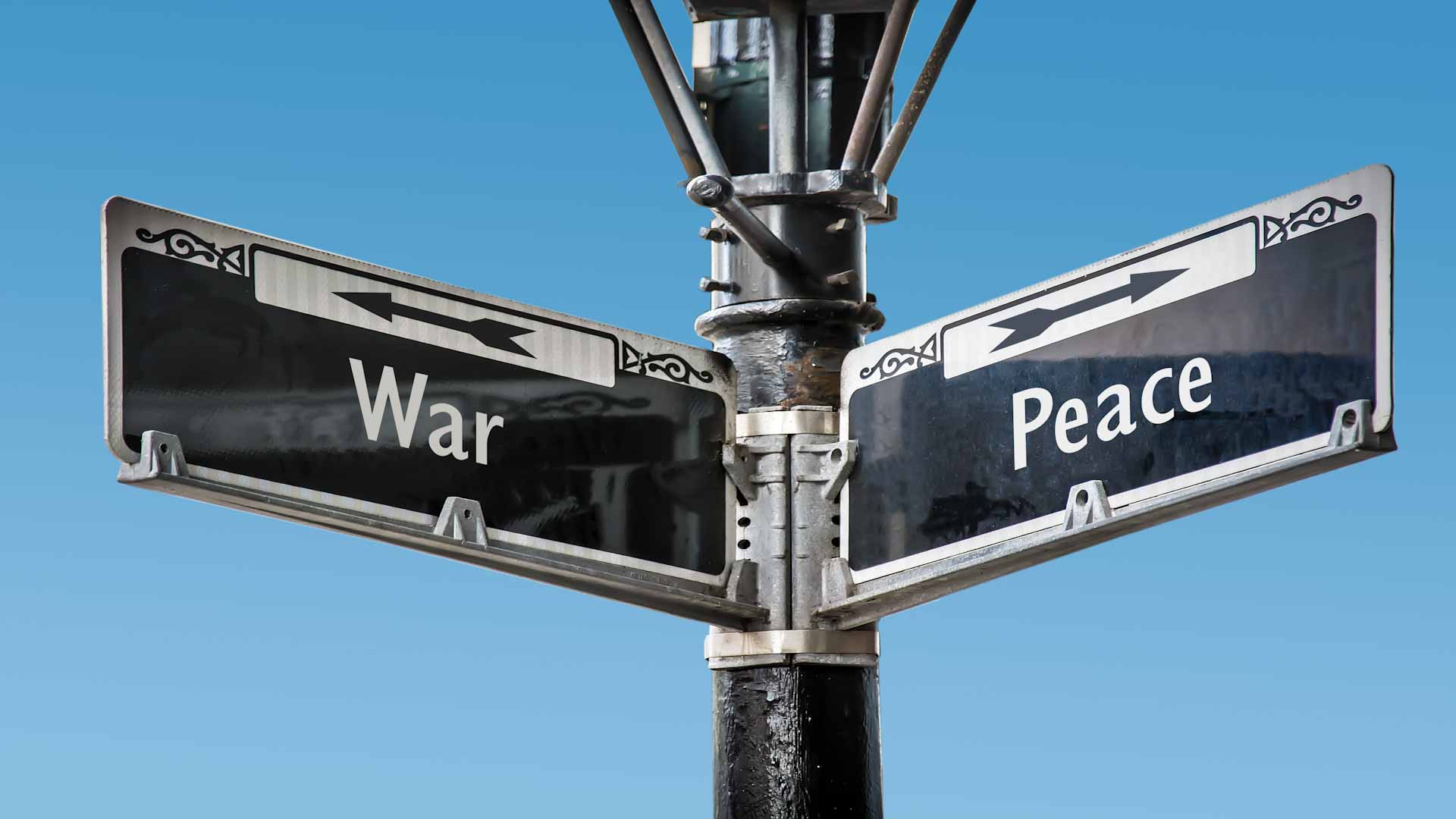
Russia's war continues – and Ukraine knows what it takes to survive. Their struggle is not just their own. It affects us all, including in Sweden. For those who lead in total defense, the question is not om The war can come here, without how We must be prepared when it does. Already today, we need to prepare to act in uncertainty, build resilience, and hold together both the nation and our membership in NATO.
Leadership determines whether we pass the test – and whether we do so on time.
In a video speech posted on the Russian Defense Ministry website at the end of August, Russian Chief of the General Staff Valery Gerasimov declared that Russia has no plans to stop its attacks on Ukraine: “The special military operation continues with offensive operations. Today we will clarify the autumn's mission.”[1] The message comes as no surprise, despite President Trump's hopes for peace talks this summer. No real peace is in sight.
Russia's goal is clear, as it has been for a long time. Ukraine should not exist and Russia claims the right to rule over countries that are independent. Russia wants to break up the EU and NATO in order to achieve its goal of redrawing the European security order, where it will dominate at least Eastern Europe.
When Russia made its demands in the fall of 2021, Sweden and Finland were in the Russian sphere of influence, as the Kremlin considered itself to have a veto over Swedish and Finnish membership in NATO. To achieve that goal, Russia is using the entire toolbox of dictatorship. So regardless of what is said about peace negotiations, ceasefires or anything else, Russia's war will continue.
Russia is a revisionist power that wants to redraw the map. This realization should have dawned on the West during the twelfth year of war against Ukraine, full-scale since 2022. If a negotiation does not give what Russia wants, it will take it when it can a little later. History is clear; Russia has a series of broken agreements behind it, such as the Budapest Memorandum that guaranteed Ukraine's territorial integrity and the two agreements in Minsk from 2014 and 2015.
Anyone who believes in negotiations and that they can yield results has been deeply disappointed when faced with an opponent who sees negotiations as a way to gain advantages towards their ultimate goal. The clash was already described by Henry Kissinger in 1957, and is reproduced by Robert Kaplan in the book Waste Land, as status quo powers (like the EU and Sweden) see negotiations and peace conferences as a means to achieve progress; for countries like Russia, it is just a means to buy time before the next aggression is carried out. A peace on Russia's terms is therefore not an end, but a pause. A time to catch your breath, recharge and prepare for the next offensive. And it may come in our part of the world, faster than you would like to believe.
When Ukraine's former commander-in-chief Valery Zaluzhny, today ambassador to London, summarized the years of full-scale war in ten lessons for Ukraine, and beyond Ukraine, it is not theoretical but reality built on experiences that Ukraine has paid with blood.[2] These are lessons from a country that has to fight every day for its continued existence, the conclusions can be described as a survival manual for small states facing an empire-hungry superpower.
Zaluzhnyj emphasizes that the enemy is eternal: Russia's goal is not compromise, but submission and annihilation. To no one else will die in your place – international support is crucial, but one's own ability to withstand initial attacks is vital. He warns that internal division is the enemy's best weapon and that it is the whole society fighting – not just the armyHe emphasizes that technology decides – drones, cyber defense, AI and electronic warfare are the lifeblood of modern warfare – and that asymmetry is the strength of the smart, when cunning, precision and boldness can outweigh numerical disadvantages. Equally important is that information is a battlefield: the battle for people's minds is as important as the battle on the battlefield, the war is won and lost in people's heads. And for management, it is trust the key: a centralized system paralyzes, while mission tactics and decentralization provide speed and endurance.
Zaluzhnyj's final words are perhaps the most poignant to realize: resilience is a strategic resource. Wars are not won in days, but in the ability to withstand months and years. And it is not the peace that is victory, when peace comes, it is not enough for the guns to fall silent – true victory is restoring freedom, rebuilding society, and ensuring security for future generations. Anything that does not achieve this is just a delayed loss.
Zaluzhnyj's conclusions are not just Ukraine's. They speak directly to our own history. Sweden realized already during the Second World War, when the threat was at our borders, that the survival of a small democracy is always the task of the entire society. That is why we built total defense – an insight that is now once again becoming relevant and urgent.
When the brochure If the war comes was distributed to all Swedish households in 1943, the words were: “Modern war is not just a showdown between military forces. It affects everything and everyone."[3] Eighty years later, it almost sounds like a commentary on Ukraine today. Total war requires total defense.
The so-called Mossberg investigation in 1953,[4] which preceded modern psychological defense, also pointed to the cognitive aspects that Zaluzhnyj highlights in his ten points – that information is a battlefield. In the Swedish investigation it is expressed as follows: “Military warfare ultimately has a psychological purpose in that it is aimed at breaking the enemy's will to resist."[5]
Sweden's own reality
The national security strategy speaks clearly: we are in the midst of the most serious security situation since the Second World War. Prime Minister Ulf Kristersson's words that we are not at war, but not at peace either, ring true to our times: sabotage against cables on the bottom of the Baltic Sea, disinformation campaigns in social media, cyberattacks against companies, authorities and municipalities. It is a war without a declaration of war, which is not always visible in everyday life, but with very tangible effects. Where armed conflict can occur if Russia finds the circumstances favorable to achieve its political goals of a resurgent Russian empire, with a sphere of influence far beyond today's borders and a new order in the world that is based on the right of the strong.
The Nordic military intelligence services all warn in unison. The Danish military intelligence service says that Russia may have regained enough capacity for a regional war within two years of a ceasefire or a lull in fighting in Ukraine. It is a war in the Baltic Sea region. The Norwegian intelligence service reminds us that the Arctic is a conflict zone. The Finnish military intelligence service warns that “bowing to Russia’s demands would likely make future escalation spirals even more dangerous than before.”[6] Swedish MUST calls it systemic confrontation and that experience shows that the Russian leadership chooses to start a war against its neighboring countries under circumstances that it perceives as favorable.[7]
In parallel with the threat picture, Sweden finds itself in a time of rebuilding its total defense. It is urgent to reclaim the old in a new, modern and relevant form.
The prerequisite report is a Swedish compass
Every two years, the Center for Total Defense and Societal Security (CTSS), at the Swedish National Defense University, produces the book "Conditions for Crisis Preparedness and Total Defense".[8] The prerequisite report is a cornerstone of knowledge about Swedish total defense and is used in training at the center. The report summarizes legislation and systems for crisis preparedness and total defense, but also the threats and what is happening in the area. It is a map of where Sweden stands – but also what needs to be done.
The picture of the conclusions for the Swedish part becomes even clearer when we cross-analyze the Prerequisite Report and Zaluzhnyj's lessons:
- The enemy is eternal ↔ Russia is a long-term threat. Sweden must plan for decades, not terms of office. Nor will the war be short as we have long thought, but we need to understand that we could be in a long-term conflict for many years with no discernible end – let's call it "an eternal war", with or without military conflict.
- No one dies in your place. ↔ NATO provides security, but Sweden must withstand the first few weeks itself before help arrives. If we are not prepared to fight for ourselves, or for our neighbors, we cannot count on anyone else being prepared to fight for us. NATO does not replace our own capabilities. The basic idea of total defense does not change with NATO membership, but NATO adds extra strength, more dimensions and a responsibility that goes beyond our own borders and that we need to shoulder.
- Fragmentation ↔ Hybrid threats aim to undermine trust. National unity is crucial, as is unity within NATO and the EU. Here, Sweden has a national strength in the form of unity on the threat perception, armament and support for Ukraine in the Swedish parliament. But can we maintain unity when the threat increases and we enter an election year? How do we avoid the enemy dividing us in Sweden and between allies.
- The whole country is fighting ↔ Civil and military defense must be woven together into a total defense, where the mindset must put the whole, the state system and the continuity of society before other goals that we guide operations from in peacetime. Civil society, business, municipalities and regions are just as important as the brigades in building the endurance that victory will require of us.
- Technology ↔ Things like cyber capabilities, drones, AI and EW are not complements – they are central technology areas in modern warfare. Here the pace of innovation needs to increase and Ukrainian experiences need to be continuously implemented in capability building.
- asymmetry ↔ Smart, targeted capabilities like robots and cyber provide the opportunity to hit the opponent where it hurts. Creativity, innovation and courage are needed in warfare.
- Information ↔ Disinformation has been around for a long time. Psychological defense must be a cornerstone. But since we are already in a conflict and the global arena has no borders, we also need to start acting offensively to influence our adversary, even before the attack occurs.
- Leadership and trust ↔ Mission tactics and a decentralized capability in the total defense system are Swedish strengths that must be built upon. It also requires that everyone understands their responsibility and Sweden's security policy situation and goals. War requires cooperation with effect, not collaboration and processes without results.
- Resilience is a strategic resource ↔ Supply readiness in energy, food, transport and healthcare is the core of total defence, we must build rapid adaptation and adaptability. This will require innovation, flexibility and perseverance.
- Victory beyond peace ↔ For Sweden, this means building long-term and not just “getting through the crisis” or a quickly flaring war, which is over in a few weeks. Anyone who has peace as their primary goal has lost their freedom before the war has even begun.
Your responsibility in total defense
For those of you who have a task to lead others in total defense, you already need to prepare yourself and your organization to quickly adjust to operational total defense. Leadership in peace is one thing – leadership during war is something completely different. When society is exposed to an existential threat, every leader is tested. Then it is not enough to rely on manuals, routines and perfect documentation. Decisions must be made in chaos, and the consequences extend far beyond your own organization.
The war will affect you and your employees, in the worst case in the most brutal way. It places demands on your endurance, your ability to adapt, your courage and your determination to dare to act without the perfect basis. It requires knowledge of how people react when the unthinkable happens, and an ability to handle the situation. It also requires that you see your greater responsibility for Sweden in a whole that goes beyond the narrow peacetime logic you have learned to act. It challenges decades of management thinking and governance models. The time we are in requires that you understand that you are not just leading your organization - you are leading part of the entire Swedish collective resilience in the total defense. If you and your organization falter, it will have consequences for others far beyond your own operations.
Therefore, you need to…
- Building insight – you and your employees need to understand the threat landscape and what drives our adversaries. Start small, take Säpos and MUST's annual reports and have a study circle in the management team. What does this mean for us?
- Practice decision-making under uncertainty – don't wait for full information. Acting is better than standing still.
- Building trust and collaboration – civilian and military together, not separately. Get to know the person you need to call and who is currently at other authorities, in business, in another municipality or in our neighboring countries.
- Prioritize innovation – how can your organization shorten the time it takes to get new knowledge into the business?
- Strengthen endurance – energy, food and healthcare are as important as weapons for the sustainability of society. They are needed throughout society, but what does your organization's sustainability look like until society has had time to adjust to the demands of war?
- Own the narrative – information influence is best met with clarity, honesty and sustained communication. But it must also be proactive – with strategic communication about your own story. As a communications manager, you must think in several dimensions at the same time so that your communication supports what Sweden communicates to its own population, to allies and towards our adversaries.
When the Russian Chief of the General Staff Valery Gerasimov says that Russia does not intend to end the war, we should take him at his word. The course in Moscow has been set for a long time, and we know what Russia wants to achieve. When Prime Minister Kristersson says that we are not at peace, it is to emphasize that the threat is here and now. When our Nordic intelligence services warn that Russia may be ready for a new war when circumstances are favorable to Russia, it is a message that requires action – not in two years, but today. Not acting today is like inviting war to us.
Zaluzhnyj's ten points are not just Ukraine's. They are ours too. They are a map for how we must lead and rebuild our total defense. For the question we must ask ourselves is not whether we can afford to prepare – but whether we can afford not to. And whether we have time to wait to do it until tomorrow, when we need to do it today.
This text was written as part of my preparations to sit on a panel at the conference Tomorrow's Total Defense in Karlstad together with Professor Aida Alvinius at the Swedish National Defense University and talk about leadership in total defense. One of the questions we received from the audience was about how President Zelenskyj manages to go to work every day, year in and year out, with the pressure he has.
My answer was simple: Zelenskyy can do it because he bears a responsibility greater than himself. The day you face the same test, you too will – because together we understand that we are not just fighting for our own everyday lives, but for freedom, for our children, and for the society we want to leave behind.