

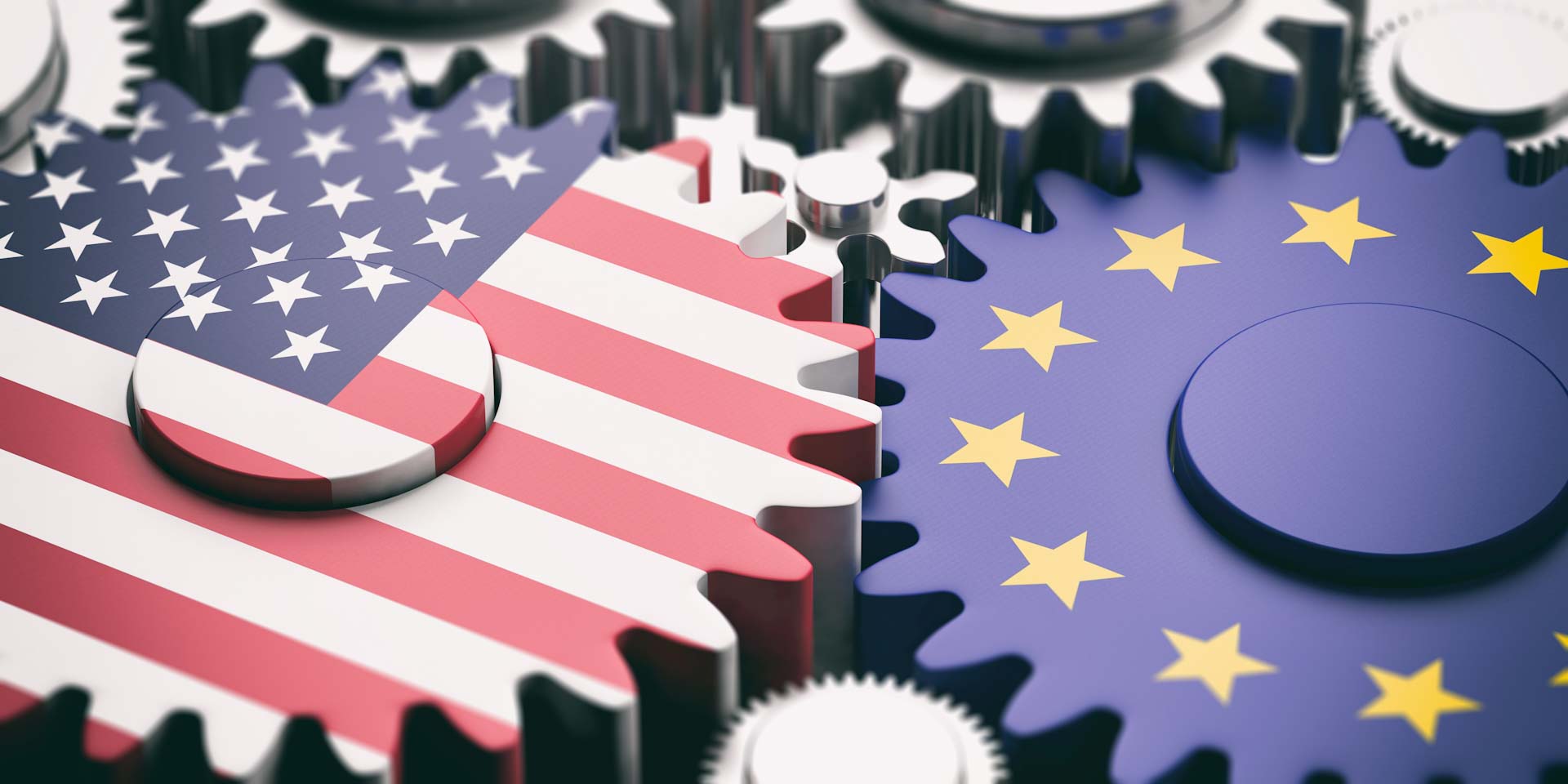
The rapid development of events and the abrupt shifts in American foreign policy create a cavalcade of impressions that risk distracting our attention from the issues that are of central and long-term importance to the continent of Europe.
European security policy in the broad sense should ideally not be characterized by individual reactions to the actions of the outside world. We should formulate a coherent line more clearly than now, partly as part of our own list of actions, and partly as a basis for communication with the outside world, not least with the United States.
In just over two and a half years, Americans will elect a new president. We don't know who will be elected, or even who will run as candidates, but one of two things will likely happen as a result of the election:
- A new administration continues along a similar line to the current one. The need for a strong European security policy, based on its own capabilities, remains undiminished.
- A new administration is changing tack and making efforts to repair the trust that has been shattered in a short time. Such an attempt can easily lead to disappointment. We cannot be sure that the US political class has fully understood the extent of the deep European distrust that has arisen and that will take a long time to repair.
Regardless. The goalposts have been permanently moved. Transatlantic relations in 2029 will not be the same as they were in 2024.
Possible components of a reasonably common European line
None of the above options are particularly attractive to Europe. However, a coherent and well-communicated European line could be a way to reduce the negative consequences, regardless of how the presidential election turns out. Some points that we could develop and communicate with our American allies:
- Our common opponents, primarily China and Russia, see a divided West as something positive. Division within different countries (e.g. through populist movements such as Reform UK, AfD, MAGA, etc.), within Europe (e.g. Brexit, Hungary/Slovakia) and between the US and the West in general (tariff war, etc.). It is in the interest of the entire West – and here we have a shared responsibility – not to meet our opponents in Beijing and Moscow. The ties across the Atlantic are worth protecting and we should show our willingness to do just that.
- Trade or technology wars within the West have no winners, although different parties may lose to different degrees. Our interdependencies are too many and too tightly woven. The most likely winner will probably be China, which is probably not the intention. This may be the main argument against current US policy
- Responsibility for Europe's defense. It is fundamentally sound that a populous and prosperous Europe is not dependent on others for its military defense. We should not even try to argue against it. At the same time, it is obvious that independence is not just a question of money. It also requires its own capabilities, such as management, logistics, weapons systems, production capacity, intelligence capabilities – and deterrence. A US that withdraws from Europe must therefore expect that our continent will replace American capabilities with domestic ones, with everything from aerial refueling and satellites to calculation programs and AI. We cannot be clear enough on this point. Perhaps we should sketch out a timetable together with the US, so that everyone involved has a common picture of the work ahead of us and the time it will take to implement the change.
- We should speak plainly about the obvious difference between the United States (one country) and Europe (many countries, no dominant language and a political union that does not include everyone). Henry Kissinger's famous question "Who do I call in Europe?" is easy to answer. There is no one to call and the significance of this simple fact must be understood and embraced by the US political leadership. The EU is a political union, the European part of NATO something else entirely and the continent is a third definition. All quite loosely held together by a few dozen languages and a period of more than a thousand years of countless internal conflicts while the US has had a single civil war.
- Good allies do not try to influence each other from within, do not try to divide each other, and do not perform other unfriendly actions towards each other. This makes Marco Rubio's visit to Orbán in January and JD Vance's simultaneous visit to the German AfD somewhat troubling. Hungary has developed into the EU's most corrupt country (Transparency International) and both destinations are characterized by both distrust of Brussels and a positive view of Putin's Russia, incidentally the same Russia that is said to have assisted the US enemy Iran with target designations during the ongoing conflict. It also recently became known that Hungarian Foreign Minister Péter Szijjártó has on a number of occasions called his Russian colleague Lavrov in connection with meetings in the European Council. Hungary has previously denied that this has happened. If Europe – purely hypothetically – were to start approaching Texit (advocates for an independent Texas), it would probably not be appreciated in Washington D.C. Perhaps we should ask the Trump administration for clarification on the US's choice of friends on our continent.
- The United States is criticizing developments in Europe. Vice President JD Vance has expressed strong concerns about freedom of expression, and so have others in connection with disputes between European lawmakers and American media platforms. In addition, we have American concerns about Europe's social conditions and our ability to integrate immigrants. We Europeans could dismiss all criticism by pointing to extensive shortcomings in American freedom of expression, such as President Trump's repeated criticism of everything he perceives as "fake news," American drug abuse, or a number of other social problems that seem to be far worse in the United States than here. But that is not the right way to go. It is better to take the criticism seriously and reflect on what we can do better. An example of potential for improvement is former Italian Prime Minister Mario Draghi's report on European competitiveness, which came out in 2024 and pointed to a number of economic shortcomings, but the EU's reaction has so far been anything but forceful. Of course, these are circumstances that can lead to criticism of Europe.
Conclusion
In all that is happening now, we must not forget the basics. Russian imperialism is and will remain the defining threat to our continent. The United States is, for a number of good reasons, our friend and our natural ally, and we should cherish the relationship, today and in the future. The fact that the United States withdraws from responsibility for Europe's defense is in itself completely natural and should not be seen as a threat.
At the same time, not all interests coincide. A European defense buildup will not be based on the acquisition of American weapons. Neither Europe, nor other continents, regions, nor individual countries will subordinate their own long-term interests to those of the United States. Quite the opposite. The thinking behind MAGA is likely to provoke responses in other countries. Actions have consequences.
The upcoming elections in 2028 are unlikely to fundamentally change the situation. Talk of Prime Minister Carney as the “51st governor of the United States” or of the need to “own” Greenland will be with us for a long time. Despite this, the countries of Europe, both individually and collectively, should stick to the line of “friendship and alliance”. We should listen to the criticism of others without prejudice and self-critically, while at the same time being as cool and clear as possible in cases where our interests are not the same as those of the United States.