

The description of Russia as “increasingly aggressive” is, to be honest, starting to get a bit over the top at this point, but after a series of attacks and revealed attack plans – mainly by the drones at Leipzig airfield – it’s hard to argue against it. What’s harder to reach a consensus on is what Western countries should do about it. Most people seem to agree that it’s unacceptable for Russia to carry out sabotage actions that have already cost lives and caused economic costs, but with the exception of diplomatic expulsions and threats of further strengthened sanctions, the toolbox seems to be pretty empty.
At the same time, the threat does not end with burning factories or downed planes. The question of whether an increasingly desperate Kremlin might go even further to try to force an end to the war in Ukraine was raised again in connection with CIA Director John Ratcliffe’s visit to Moscow in late August. An escalation aimed at NATO countries in the hope of both splitting the alliance and diverting the resources that the EU and NATO countries are supporting Ukraine may seem far-fetched and extremely risky, but Putin would not be the first player to try to cover his losses by raising the stakes in the next round.
One of the big problems is another well-worn cliché, namely the one about how the line between war and peace is blurring, and that instead we have to deal with an increasingly violent gray area. The problem here, just like with the idea of an increasingly aggressive Russia – is that it is true. Concepts such as hybrid warfare are easily problematic as hybrid attacks can include everything from carelessly constructed troll networks that try to sow discord to direct terrorist attacks, but at the same time it is impossible to avoid the fact that the situation as a whole does not directly correspond to the scenarios for which our law books are written. It is not war, but it is not peace either.
Leipzig was an attempted state-sponsored terrorist attack, and we see no signs that Russia intends to stop using these in the West as one of the tools in their toolbox.
Which brings us back to the question, what do we do now? Broadly speaking, there are two options: Accept that Russian terrorist acts occur at regular intervals, with the economic costs and loss of human life that this entails, or take measures that successfully deter the Russian leadership. If you ask the question to leading politicians, I dare say that most of them find the first option unacceptable, and therefore answer option two. But if we look at what is actually happening, it seems on the contrary that we accept this level of attacks without any major problems.
Are we as helpless in the face of Russian aggression as it sometimes seems? The answer is “no”, but we need to decide at what stage the attacks become so serious that we choose to respond with force. There is a strange lack of both historical knowledge and creativity when our response options are often described in the public debate as the next step on the ladder being full-scale war and NATO’s Article Five, while during almost the entire post-war period we have seen examples of limited military operations to put pressure on hostile states to change their behavior. Recent examples include the raids targeting Syrian chemical weapons and the infrastructure around them carried out in April 2018 by the US, France, and the UK, and Operation El Dorado Canyon, which during the Cold War featured a large coordinated American air raid on several targets in Libya in response to a bombing attack on the La Belle disco in West Berlin.
An “Operation Kaliningrad Canyon” where NATO strikes a limited number of Russian targets in a time-limited operation has, as far as I can remember, not been raised as an option at any stage of the debate, despite it having previously been a relatively widely used tool to (at least try to) put a stop to state-sponsored terror. Such a raid with aircraft and cruise missiles could even be announced in advance, since it is possible to rely on long-range weapons that reduce the risk to one’s own personnel to a level where the risk can be balanced against the risk of escalation, and the targets could be chosen to be of strategic value but not affect the Russian nuclear arsenal. Suitable targets could, for example, be the GPS jammers that have created risks for civil air traffic and shipping, or the Russian survey ships that have not made much effort to hide their interest in Western critical infrastructure on the seabed.
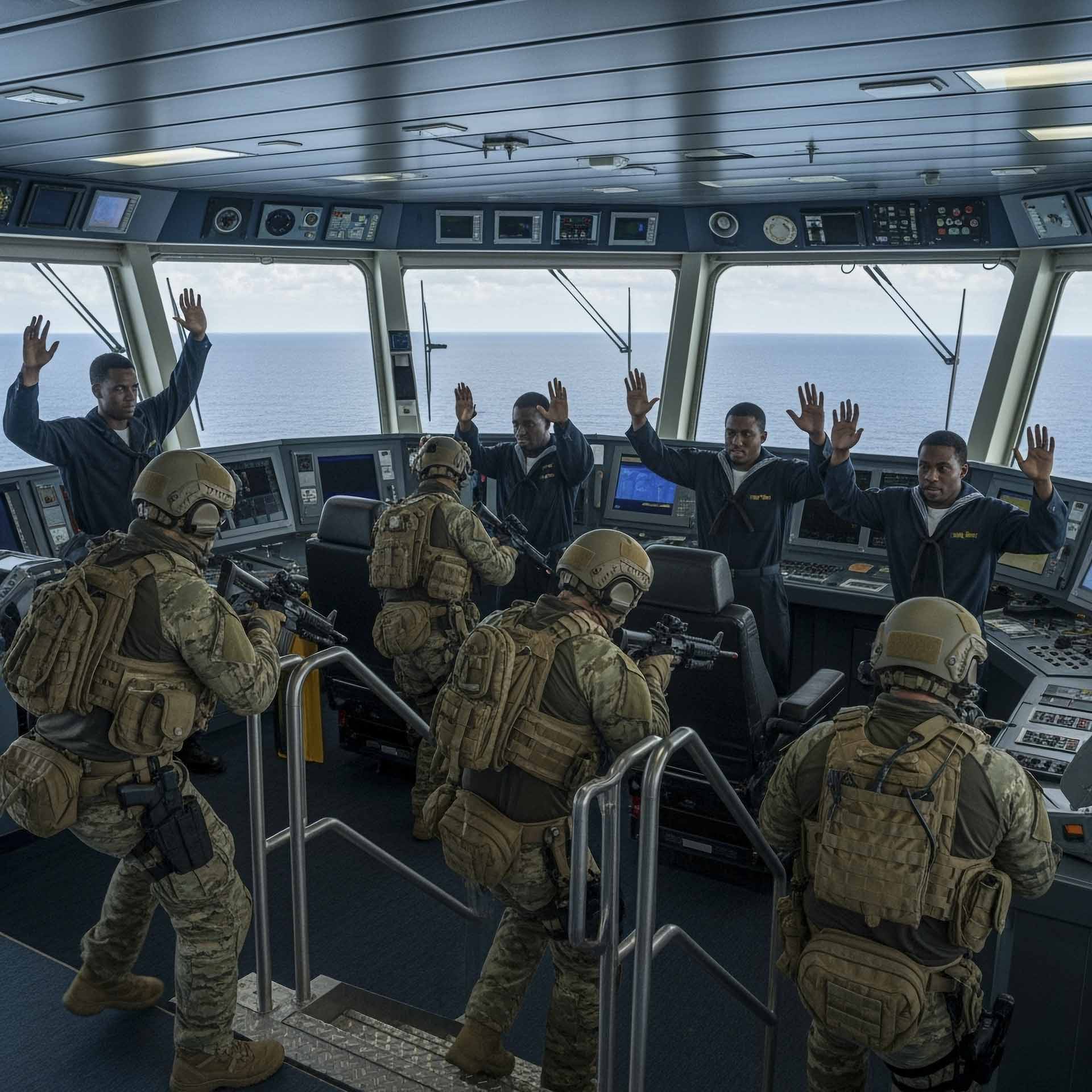
Are we on the escalation ladder? Not in my opinion, but on the other hand, it is strange that we have not yet begun to discuss what options we actually have. There are also a number of other powerful measures that can be taken that clearly signal that Russian violence will have consequences. Boarding and taking into custody any of the above-mentioned survey vessels can be carried out with relatively low risk to both our own and Russian personnel on the high seas. More aggressive measures to stop traffic with the so-called shadow fleet is also an option that has received, or at least should have received, new attention after the oil disaster that threatens a nature reserve off Oman when the Cameroon-flagged Caroline Bezengi ran aground after the crew abandoned the ship in connection with an explosion that apparently originated from a suction mine attached to the outside of the hull.
Why are none of these options being discussed, even though the conflict we are in is becoming increasingly violent? It is a bit unclear, but respect for Russia as a great power in decline and their unpredictable actions is a factor. At the same time, it is a bit worrying that it does not seem to be thought of in terms where the answer to armed force with armed force is a clear alternative. For smaller NATO countries close to the Russian border, such as Finland and Sweden, it is of absolute importance that even limited Russian operations across the border in, for example, the Baltics are seen as direct acts of war, and are met with aggressive countermeasures. In plain language: if Russian soldiers cross the border in the Baltics to try to establish a frozen conflict, Finland does not need to send the army against Vyborg, but mobilization, a closure of the Gulf of Finland and air raids against strategic targets in the vicinity should not wait for any longer political processes in Brussels, but one needs to act in accordance with the Washington Treaty bilaterally and minilaterally without waiting for a formal implementation of Article 5, as the latter may be delayed by individual reluctant countries.
I would argue that there is a connection between these two issues. One answer to the question of why stronger measures against Russia are not being discussed may be that many still do not see an armed conflict with Russia as a scenario we can face, regardless of whether we want it or not. And if you cannot imagine situations where the right response to Russian measures is that we need to climb the escalation ladder, you probably have not thought through which scenarios are where our defense forces should be deployed against Russian targets, in what way and to what extent. Then it is worth the risk that if you end up in a truly serious situation – where it is not just about terrorist acts but about outright border fighting between Russian units and our allies – it will take too long to react to the reality you find yourself in.
Right now may not be the time to respond to Russian violence with force, but it is time to discuss what our alternatives are. Because there is a risk that when someone says that they are already at war with us, they may mean what they say.